
Organic Chaga Mushroom Extract Powder For Immune Boosting Latte
Sep 08, 2026
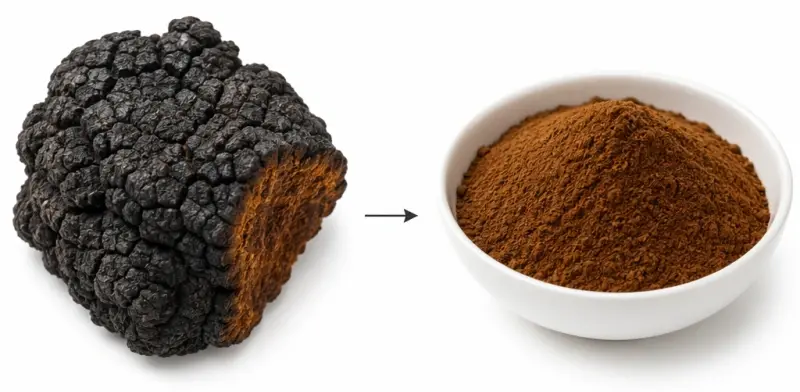
Organic chaga mushroom extract powder for immune-boosting lattes represents a premium botanical ingredient that transforms ordinary beverages into functional wellness drinks. Derived from the sclerotium of Inonotus obliquus, Chaga Mushroom Extract Powder undergoes dual extraction to break down chitin cell walls, releasing bioavailable beta-glucans, triterpenes, and polysaccharides. This standardized extract solves the bioavailability challenges found in raw mushroom materials, offering beverage manufacturers a consistent, water-soluble ingredient that dissolves fully in hot liquids while delivering concentrated immune-supporting compounds that consumers actively seek in today's health-conscious market.

Organic Chaga Mushroom Extract Powder is different from raw mushroom material because it has been processed in an advanced way and has a lot of bioactivity. The extraction process frees the beneficial compounds from raw chaga that are stuck inside chitin walls that can't be digested. This makes a powder that is easier to absorb and has a consistent level of potency. This difference is very important for people who make drinks because they need to be able to predict the results of each batch.
The Extraction Process and Its Advantages
The dual-extraction method uses hot water and pressure ethanol to get polysaccharides that dissolve in water and triterpenes that dissolve in alcohol, such as betulinic acid. Through this thorough process, the end brown-yellow fine powder is guaranteed to contain all of chaga's healing chemicals. This extract is based on raw materials from Siberian chaga that were collected in the wild. The birch trees in the wild add phytonutrients that aren't found in farmed types. The process fixes a major problem in the industry: unprocessed mushroom powders don't always have the same amount of potency, which can hurt the effectiveness of the product and consumers' trust in it.
Key Bioactive Compounds
There are three main types of compounds that make chaga useful in immune-boosting products. Beta-glucans, especially the (1-3),(1-6)-beta-D-glucan structures, work with immune receptors to change how cells react (Wasser, 2002). Triterpenes, such as betulinic acid at concentrations of 1% to 3%, help the immune system work better by reducing inflammation. Polysaccharides at concentrations of 10 to 50 percent help the immune system and are good as prebiotics. The melanin level also acts as an antioxidant, which protects cell structures from oxidative stress. This is an important factor that is becoming more and more important in current health products.
Historical Context Meets Modern Applications
Chaga has been used in traditional medicine systems in Russia and Northern Europe for hundreds of years. People knew it could make them stronger long before lab tests proved this. Modern functional beverage development builds on this history by adding chaga to mushroom coffees, adaptogenic drinks, and wellness teas that people who want natural immune support like. To go from being a folk remedy to a standard ingredient, extraction technology and quality control had to get better. These improvements now allow for consistent commercial production.
Benefits of Organic Chaga Mushroom Extract Powder for Immune Boosting Lattes
Adding chaga extract to immune-boosting drinks makes items that are good for you in more ways than one, like making them healthier. These perks are great for today's consumers, who care a lot about taking charge of their health and buying foods with clean labels.
Immune System Modulation
Beta-glucans in chaga extract turn on natural killer cells and macrophages, which makes the body's defenses against pathogens stronger (Glamočlija et al., 2015). This modulation is not the same as simple activation; it helps the immune system react correctly to real threats while keeping things in balance. In drink mixes with 500 to 1000 mg of standardized extract per serving, these immune-boosting polysaccharides are present in meaningful amounts. This makes products seem like real functional solutions instead of just health claims.
Antioxidant Protection Against Oxidative Stress
Oxygen Radical Absorbance Capacity tests show that chaga has some of the highest scores of all natural substances, and Chaga Mushroom Extract Powder delivers this benefit. This is because it contains melanin complexes and phenolic chemicals. This antioxidant ability gets rid of free radicals that build up because of stress, the surroundings, and the body's own processes. For latte flavors, this means a great marketing opportunity: drinks that actively protect cell health while people go about their daily lives.
Multi-Dimensional Wellness Attributes
In addition to improving defense, chaga extract also boosts energy through adaptogenic processes that help the adrenal glands work without overstimulating them. The triterpene content reduces inflammation, which may be good for joint health and signs of systemic inflammation (Zheng et al., 2010). Both the antioxidant effects inside the cell and the protective properties of melanin are good for skin health. This adds to the value of beauty-from-within beverage ideas. With all of these benefits, product designers can market immune-boosting drinks as complete health solutions that are worth the higher price.
How to Incorporate Organic Chaga Mushroom Extract Powder Into Immune Boosting Lattes?
Paying attention to dosage, preparation methods, and quality control is important for a successful formulation that works and appeals to consumers. It's helpful for manufacturers to know the technical details that set average products apart from market leaders.
Dosage Guidelines and Preparation Methods
Commercial coffee that boosts your immune system usually has between 500 and 1500 mg of chaga extract powder per serving. 1000 mg is thought to be the best amount for a good mix of effectiveness and cost-effectiveness. The small particles—100% of them fit through an 80-mesh sieve—ensure a smooth texture and full dissolution in hot liquids above 70°C. The earthy taste goes well with coffee, cocoa, and chai spice blends on their own, but some formulators add vanilla or cinnamon to make the mushroom notes less strong. The powder dissolves better if you mix it with a little hot liquid to make a paste before adding the full volume of the drink. This keeps the powder from sticking, which can change how it tastes and feels in your mouth.
Quality Standards and Certification Requirements
In B2B buying, specifications are very important. Organic certification checks that farming methods are proper and that synthetic pesticides are not used, which meets the requirements of clean labels. Heavy metals testing (≤10 ppm) keeps food safe from industrial areas that might contaminate it, and microbial limits (Total Plate Count <1000 cfu/g, Yeast & Mold <100 cfu/g) keep food safe throughout its shelf life. Loss on drying (≤5%) and ash level (≤5%) show that the extraction was done correctly and there was little to no adulteration. Certifications like ISO 22000, HACCP, Kosher, and Halal make it possible to sell goods in markets with a wide range of rules and customer needs. This is why sellers who work with global beverage brands need to have these qualifications.
Real-World Application Success
A medium-sized functional beverage company released an organic immunity latte line using standardized chaga extract with 30% polysaccharide content. The products did very well in the market because they were easy to understand and tasted the same from batch to batch. The company that made the product chose a 20:1 concentration ratio that delivered strong bioactives while staying within their cost goals of selling each serving for less than $5. Within six months, the product was sold in more than 500 specialty stores. This shows that adding quality chaga can lead to economic success as long as the formulation factors match what customers want and the supply chain is reliable.
Choosing the Right Organic Chaga Mushroom Extract Powder Supplier
Choosing the right supplier for Chaga Mushroom Extract Powder has a direct effect on the uniformity of the product, compliance with regulations, and the long-term success of the business. To find partners who can help with growth, procurement teams need to look at more than just price.
Critical Procurement Criteria
Compliance with standards is the basis for judging suppliers. For example, ISO 22000, HACCP, and organic certifications show that quality management systems are in place. Batch traceability lets you quickly respond to quality questions and government audits, and the Certificate of Analysis paperwork for each lot makes sure that the specifications are met. With OEM and private label options, beverage makers can create their own formulas and packages, which helps them stand out in the market. Suppliers with flexible MOQs can handle both the development phase of a product and large-scale production, which lowers the amount of capital needed for market testing.
Extract Type Comparisons
Organic versus non-organic buying changes how a product is positioned in the market and how much it costs. Organic products cost 20 to 30 percent more but can be sold in higher-end stores. Full spectrum extracts that contain both water-soluble and alcohol-soluble chemicals are better than isolated polysaccharide extracts in many ways, though some uses may prefer one part over the other. Different quality control methods are used for concentration ratios (10:1, 20:1) and standardized percentages (Polysaccharide 30%, Triterpene 2%). Standardization makes sure that bioactives are delivered consistently, even if the raw materials are different, which makes the formulation more reliable.
Supplier Profile Considerations
Leading suppliers have controlled relationships with people who collect wild plants in certified areas. This makes sure that the raw materials are real and that the practices are sustainable. Modern extraction tools and production facilities that follow good manufacturing practices (GMP) make particles that are the same size and dissolve easily in water, which is important for beverage uses. Technical support teams help with things like improving formulations, testing for stability, and preparing regulatory paperwork, which adds value above and beyond the supply of commodities. Local warehousing in important markets like the US cuts down on wait times and freight costs, which makes the supply chain more flexible for just-in-time manufacturing.
Purchasing and Logistics: Navigating the Buying Process for Bulk Organic Chaga Extract Powder
Quality control, cost management, and supply chain dependability must all be balanced for efficient buying to support continuous production while lowering the costs of holding inventory. Knowing the buying scene lets you make smart choices that protect both the quality of the product and your business's bottom line.
Sourcing Channel Evaluation
Specialized botanical ingredient suppliers usually have better technical support, quality documentation, and formulation help than general markets, but the unit costs are a little higher. These connections give you access to custom specs, priority handling when supplies are low, and resources for working together to make new products that generic providers can't match. Marketplace platforms are great for finding prices and making small purchases, but they might not have the legal paperwork and batch stability that is needed to make food and drinks for sale. Instead of just looking at platform reviews, you should check the vendor's business licenses, facilities, and customer references to get a sense of how trustworthy they are.
Pricing Structures and Commercial Terms
Chaga extract is usually priced in bulk based on volume, with discounts for 25 kg, 100 kg, and 500 kg or more. Standardized extracts are more expensive than basic concentration ratios because more money has to be spent on quality control. For new customers, payment terms usually include a 30% deposit and the rest due before the shipment. After a few transactions, terms can change to Net-30 or Net-60. Ordering samples is the best thing to do before committing to large amounts. Reliable sellers offer 50–100g samples for free, plus the cost of shipping, which lets you test the product in the lab and make small batches for formulation trials.
International Shipping Considerations
Botanical products that are labeled as food ingredients usually go through customs without any problems as long as they have the right paperwork, like a Certificate of Origin, Phytosanitary Certificate, and Certificate of Analysis. Sea freight from Asian suppliers usually takes 15–25 days to get to ports on the West Coast of the United States. Air freight can get there in 5–7 days, but it costs a lot more. Local warehousing choices from suppliers with US distribution centers offer delivery windows of one to three days, which takes the guesswork out of foreign shipping and keeps prices low by combining container orders. When you buy from local suppliers, the minimum order quantity usually goes down. This makes it easier for smaller brands and product development stages to meet your needs than when you import directly.
Conclusion
Organic Chaga Mushroom Extract Powder contains strong immune-boosting chemicals that turn regular lattes into healthy drinks that meet the needs of people who want natural health solutions. The extraction process fixes problems with bioavailability that come with raw mushroom materials. This gives beverage makers standard, water-soluble ingredients that stay potent across production batches. Brands can make unique products that compete well in the growing functional beverage market by working with suppliers that offer full certifications, technical support, and flexible payment terms. By choosing the right extract specs, checking the credentials of suppliers, and following the right formulation methods, you can make sure that your goods really help your health while still making money and following all the rules throughout the supply chain.
FAQ
What is the optimal serving size of chaga extract for immune-boosting lattes?
The suggested dose is between 500 mg and 1500 mg per serving, with 1000 mg being the best mix between therapeutic effectiveness and cost-effectiveness. While keeping the pleasant taste that people expect from everyday drinks, this amount gives us meaningful concentrations of beta-glucans and triterpenes.
Which certifications should I verify when sourcing chaga extract powder?
Some important certifications are Organic (USDA or an equivalent), ISO 22000 for managing food safety, HACCP for analyzing risks, and religious qualifications like Kosher and Halal for certain markets. Check the heavy metals tests, microbial limits paperwork, and Certificate of Analysis for every output batch to make sure the quality is always the same and that the rules are followed.
Are there any side effects or contraindications associated with chaga mushroom extract?
Chaga extract is usually well accepted, but people who take blood-thinning drugs should talk to their doctors because it might interact with those drugs. Because chaga can change the immune system, people with autoimmune conditions may need to talk to a doctor. When taken in the suggested amounts in functional beverage recipes, quality extracts that meet microbial requirements and heavy metal limits don't pose many safety issues.
Partner with Yanxi Herbs for Premium Chaga Mushroom Extract Powder Supply
Yanxi Herbs is a trustworthy company that makes Chaga Mushroom Extract Powder and supplies high-quality botanical ingredients to supplement companies, functional food makers, and beverage brands all over the world. We get our Inonotus obliquus extract from wild-harvested Siberian chaga and make sure it meets strict standards for polysaccharide (10–50%) and triterpene (1- 3%) percentages. The facilities that do the processing are ISO 22000, HACCP, Kosher, and Halal certified. We keep a ready-to-ship inventory that can be delivered in one to three days, give away free samples for trying formulations, and offer a range of flexible packing options, from 1 kg bags to 25 kg drums. Our technical team helps with OEM and private label creation by making specs that are specific to your product needs. Get reasonable bulk prices, check our certifications, and get the reliable supply chain your immune-boosting latte recipes need by emailing us at info@yanxiherbs.com.
References
1. Glamočlija, J., Ćirić, A., Nikolić, M., Fernandes, Â., Barros, L., Calhelha, R. C., Ferreira, I. C., Soković, M., & van Griensven, L. J. (2015). Chemical characterization and biological activity of Chaga (Inonotus obliquus), a medicinal "mushroom". Journal of Ethnopharmacology, 162, 323-332. https://www.sciencedirect.com/science/article/abs/pii/S0378874114008824
2. Wasser, S. P. (2002). Medicinal mushrooms as a source of antitumor and immunomodulating polysaccharides. Applied Microbiology and Biotechnology, 60(3), 258-274. https://link.springer.com/article/10.1007/s00253-002-1076-7
3. Zheng, W., Miao, K., Liu, Y., Zhao, Y., Zhang, M., Pan, S., & Dai, Y. (2010). Chemical diversity of biologically active metabolites in the sclerotia of Inonotus obliquus and submerged culture strategies for upregulating their production. Applied Microbiology and Biotechnology, 87(4), 1237-1254. https://link.springer.com/article/10.1007/s00253-010-2682-4
4. Cui, Y., Kim, D. S., & Park, K. C. (2005). Antioxidant effect of Inonotus obliquus. Journal of Ethnopharmacology, 96(1-2), 79-85. https://www.sciencedirect.com/science/article/abs/pii/S0378874104004015
5. Shashkina, M. Y., Shashkin, P. N., & Sergeev, A. V. (2006). Chemical and medicobiological properties of chaga (review). Pharmaceutical Chemistry Journal, 40(10), 560-568. https://link.springer.com/article/10.1007/s11094-006-0194-4
6. Park, Y. K., Lee, H. B., Jeon, E. J., Jung, H. S., & Kang, M. H. (2004). Chaga mushroom extract inhibits oxidative DNA damage in human lymphocytes as assessed by comet assay. BioFactors, 21(1-4), 109-112. https://iubmb.onlinelibrary.wiley.com/doi/abs/10.1002/biof.552210120

Send Inquiry
Related Industry Knowledge
- Bulk Phycocyanin Powder Supports Stable Natural Blue Coloring For Food And Beverage Production
- How Does Freeze-dried Dragon Fruit Powder Improve Natural Color In Food Applications?
- How Can Purple Yam Powder Enhance Color and Texture in Food Product Development?
- Butterfly Pea Flower Powder Delivers Plant-Based Blue Color For Beverage And Food Innovation
_1787033972542.webp)