
Purple Sweet Potato Powder for Natural Color Applications in Beverages, Bakery, and Food Manufacturing
Oct 08, 2026
Purple sweet potato powder is a useful, whole-food ingredient made from Ipomea batatas types that are high in anthocyanins. It gives drinks, baked goods, and processed foods a stable violet-to-purple colour that works well every time. As more people want products with clean labels, companies are switching from synthetic dyes like Red 40 and Blue 1 to this plant-based alternative. It is a natural colourant and a source of nutrients thanks to its high levels of dietary fibre, potassium, and acylated anthocyanins. This makes it a useful and regulatory-friendly choice for B2B sourcing teams in the food, supplement, and skincare industries.
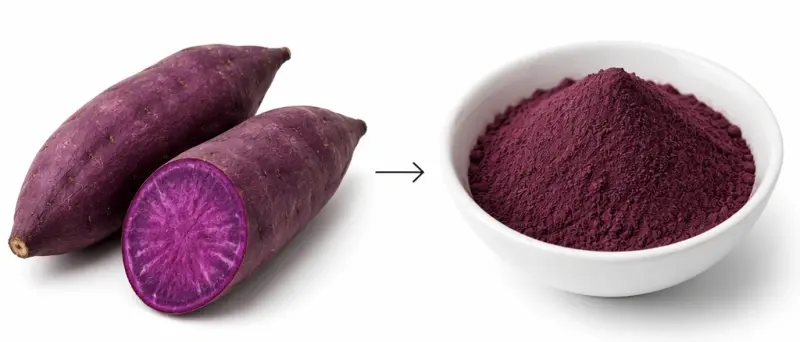
Understanding Purple Sweet Potato Powder and Its Unique Benefits
What Makes It Different from Other Natural Colorants?
Some plant-based colourants change how they work when the pH or temperature changes. You can tell Purple Sweet Potato Powder is different because it has acylated anthocyanins, which are more stable at high temperatures than the non-acylated anthocyanins found in blueberry or red cabbage extracts. These are peonidin and cyanidin derivatives. The colour stays the same during processing, baking, and extrusion because the molecules are fixed.
Nutritional Profile That Adds Functional Value
This part doesn't just add colour; it also has a certain amount of nutrients. Resistant starch, fibre, vitamin A molecules, and potassium are all found in it. This makes it useful for research and development teams that are making health-focused clean-label products. A study in the journal Food Chemistry says that the anthocyanins in purple sweet potatoes fight free radicals just as well as antioxidants made in a lab.
Gluten-Free, Non-GMO, and Organic Compatibility
This powder doesn't contain gluten and can be certified as organic or non-GMO. This makes it a good choice for purchasing managers who want to sell to people who are allergic to certain foods or on special diets. It can also carry Kosher and Halal records if it comes from known sources. Brands that want to sell their goods in the Middle East, Europe, and North America all at the same time will LOVE this.
Application of Purple Sweet Potato Powder in Beverages, Bakery, and Food Manufacturing
Beverage Applications: Smoothies, Juices, and Functional Drinks
When you mix the powder with water, it dissolves quickly and makes a thick, purple liquid. R&D teams usually use 1 to 2 teaspoons per serving for a pretty look without a strong taste. A lot of high-end juice and smoothie brands say that the body of the drink comes from the powder, which is made of whole foods. It works well in cold-pressed juice mixes, plant-based milks, and drinks that are good for you.
Bakery Applications: Bread, Pastries, and Confectionery
The Purple Sweet Potato Powder can handle some heat, which is good for use in bakeries. A dose of 3–5% by weight of flour gives bread loaves, mochi, rolls, and filled desserts strong color. An important thing to keep in mind about the recipe is that anthocyanins are sensitive to pH, which means that baking soda or egg whites will make the color more blue-green. The purple-red tone comes back when you add citric acid or buttermilk. It's possible to predict and control this behavior with the right recipe calibration.
Industrial Food Manufacturing: Sauces, Dairy, and Confectionery
This powder is a cheap and easy way for food companies to get rid of manmade colorants from sauces, dairy coatings, hard sweets, and frozen treats. Spray-dried emulsion methods work well with it, and it mixes smoothly into powder mixes. Since it's a whole-food powder instead of an extract, it gives liquids a little more texture, which is something to think about for clear sauces but not so much for dark ones.
Choosing the Right Purple Sweet Potato Powder for Your Business Needs
Organic Certification vs. Conventional Grade
First, procurement teams have to decide if organic approval is a must for the product or just a marketing choice. Organic-certified types cost more, but they can be bought in natural and organic stores in the EU and US. Conventional food-grade powder is still a good option for industrial uses that need to handle a lot of it and don't need to be certified. This is because food safety rules still need to be followed.
Key Supplier Evaluation Criteria
It takes more than just comparing prices to find the best Purple Sweet Potato Powder supplier. When it comes to B2B purchases, these are the most important factors:
- Anthocyanin verification via HPLC: Confirms the powder is authentic and not adulterated with cheap synthetic pigments.
- Heavy metal analysis (ICP-MS): Root vegetables bioaccumulate soil contaminants; Lead must be below 0.5 ppm, compliant with Prop 65 and EU standards.
- Microbiological testing: Total Plate Count below 100,000 CFU/g; zero tolerance for Salmonella and E. coli.
- Water activity (Aw < 0.3): Controls mold risk during shelf life.
- International certifications: ISO 22000, HACCP, Kosher, and Halal documentation for multi-market distribution.
The total plate count must be less than 100,000 CFU/g, and Salmonella and E. coli must not be allowed to grow.
If the water activity (Aw) is less than 0.3, it keeps bacteria from growing during the shelf life.
International certificates include ISO 22000, HACCP, Kosher, and Halal paperwork for selling in more than one market.
Comparing Purple Sweet Potato Powder Against Ube and Taro Powder
People often mix up this ingredient with ube (Dioscorea alata) and taro powders, but they act in different ways. Ube is softer, has a taste that is a mix of vanilla and nuts, and has more water in its starch. Taro doesn't make a true purple color; instead, it makes a gray-lavender tone. Purple Sweet Potato Powder has the most consistent violet color, a neutral to earthy flavor, and better thermal stability. For food coloring jobs where visual consistency is important, this is the best choice.
Quality and Safety Considerations in Procurement
Testing Standards That Protect Your Supply Chain
A trustworthy Purple Sweet Potato Powder maker will give you full batch documentation, such as a certificate of analysis (COA), pesticide residue screens for more than 500 compounds, and allergen statements. Regulatory managers who work in the US Food and Drug Administration (FDA) or the European Food Safety Authority (EFSA) must have these documents. Screening for pesticides is especially important for root tubers because they absorb soil treatments better than plants that grow above ground.
Storage and Shelf Life Management
The powder absorbs water because it has sugar and starch in it. To keep it safe, put it in aluminized bags that are vacuum-sealed and have desiccant packs inside. Keep it below 25°C and below 60% relative humidity. When you store things wrong, they quickly start to cake up and lose their color. When kept in the right way, food usually lasts 18 to 24 months. To keep the color potency consistent across batches, production managers should use FIFO (first in, first out) inventory systems.
Real-World Performance in Manufacturing Environments
There are functional food brands in the United States and Europe that have successfully added this powder to plant-based protein bars, oat-based cereals, and dairy-free frozen treats. When coming from a quality-controlled supplier, the anthocyanin content stays the same across batches. This lets R&D teams keep color specifications without having to re-formulate between production runs.
Future Trends and Strategic Opportunities in Natural Food Colorants
Growing Regulatory Pressure on Synthetic Dyes
Synthetic colors are getting more attention from the FDA and EU food safety officials. As of 2027, California's Food Safety Act limits the use of some fake colors in school food. This change in regulations is speeding up the switch to plant-based alternatives in mainstream food production. Purple pigments made from sweet potatoes are one of the most technically ready alternatives that are currently available.
Clean-Label and Sustainable Branding Alignment
Nielsen study shows that openness on product labels is a top reason why people buy things in the US. If brands switch to natural botanical colorants, they can answer this question. Mid-sized to large food companies can use sustainable sourcing stories based on growing purple sweet potatoes to help with their ESG reporting.
Processing Innovation for Better Stability
Improvements in low-temperature drum drying and microencapsulation are making anthocyanin-based powders last longer. Microencapsulated forms keep color safe from UV light and oxidation while it's being stored on a shelf. This means they can be used in new ways in clear drinks and light-exposed packages.
Conclusion
Purple Sweet Potato Powder fills a real need in the market for natural colorants: safe, stable at high temperatures, clean-label coloring that is also good for you. This ingredient works well in drinks, baked goods, and processed foods for teams in charge of R&D, buying, and quality control who have to manage recipe and compliance at the same time. When making purchases, people should look for approved sellers whose testing records can be checked, whose anthocyanins can be verified, and whose batch records are always the same. As rules get stricter and people want clear labels more, it becomes important to get this botanical ingredient from a manufacturer with a lot of knowledge and the ability to sell.
FAQ
Does the powder work for gluten-free product lines?
Yes. Purple sweet potato powder is naturally free of gluten. It is compatible with gluten-free certified formulations when processed in a dedicated or allergen-controlled facility. Always request the supplier's allergen declaration and cross-contamination policy before qualifying it for gluten-free SKUs.
How does it compare to synthetic colorants in cost?
Natural botanical colorants typically carry a higher per-kilogram cost than synthetic dyes. However, regulatory compliance costs, consumer perception value, and label differentiation offset this gap in most premium food categories. For high-volume commodity applications, bulk pricing from a direct manufacturer significantly narrows the cost difference.
What are the shelf life and storage requirements?
When stored in sealed, moisture-proof packaging with desiccant below 25°C, shelf life runs 18–24 months. Once opened, exposure to humidity causes rapid caking. Production teams should use vacuum-resealed bags between production runs and track batch dates with a FIFO inventory system to maintain pigment potency.
Why does the color sometimes turn blue-green in baked goods?
Anthocyanins react to pH changes. Alkaline ingredients like baking soda shift the pigment from purple toward blue-green. Adding citric acid, lemon juice, or buttermilk to the recipe acidifies the environment and restores the purple-red hue. This is a predictable chemical reaction, not a quality defect.
Is it fully soluble in water?
No. It is a whole-food powder containing insoluble fiber and starch. It creates a stable suspension in liquids but does not dissolve clear. This adds body to beverages, which works well in smoothies and functional drinks but may require evaluation for clear juice applications.
Partner with Yanxi Herbs for Certified Purple Sweet Potato Powder Supply
Since 2010, Yanxi Herbs has been making and sending botanical products to companies in more than 100 countries. We are a reliable source for Purple Sweet Potato Powder, and our products are certified by ISO 22000, HACCP, Kosher, and Halal. We also offer full batch documentation, custom specifications, and private label support. Our warehouses in the US and EU allow us to deliver large orders quickly. To get samples and prices, email our team at info@yanxiherbs.com or go to yanxiherbs.com.
References
1. Giusti, M. M., & Wrolstad, R. E. (2003). Acylated anthocyanins from edible sources and their applications in food systems. Biochemical Engineering Journal.
2. Zhao, C., et al. (2017). Anthocyanins from purple sweet potato: Stability and biological activity. Food Chemistry.
3. Lila, M. A. (2004). Anthocyanins and human health: An in vitro investigative approach. Journal of Biomedicine and Biotechnology.
4. Hendry, G. A. F., & Houghton, J. D. (1996). Natural Food Colorants (2nd ed.). Blackie Academic & Professional.
5. Stintzing, F. C., & Carle, R. (2004). Functional properties of anthocyanins and betalains in plants, food, and in human nutrition. Trends in Food Science & Technology.
6. U.S. Food and Drug Administration. (2023). Color Additives Permitted for Use in Human Food. FDA Regulatory Guidance.

Send Inquiry
Related Industry Knowledge
- Bulk Phycocyanin Powder Supports Stable Natural Blue Coloring For Food And Beverage Production
- How Can Beet Powder Be Used In Natural Color And Sports Nutrition Product Development?
- Chlorophyll Powder Offers Stable Plant-Based Coloring Options For Food And Beverage Manufacturers
- Food Grade Bulk Astaxanthin Powder For Skincare Antioxidant Supplements
_1787033972542.webp)