
How Does Copper Peptide Powder Help Manufacturers Create Differentiated Skin Care Products?
Sep 26, 2026
Copper peptide powder — known scientifically as GHK-Cu (Glycyl-L-Histidyl-L-Lysine Copper) — gives skincare manufacturers a measurable edge in a saturated market. This bio-identical signal peptide stimulates collagen synthesis, accelerates tissue repair, and supports hair follicle health, all at concentrations as low as 0.1%–0.5%. Unlike retinol or vitamin C, it works without triggering irritation, making it a strong fit for sensitive-skin lines and post-procedure recovery products. For R&D teams and procurement managers looking to build genuinely differentiated formulations, this ingredient offers both scientific credibility and broad application versatility.
Understanding Copper Peptide Powder and Its Skin Care Benefits
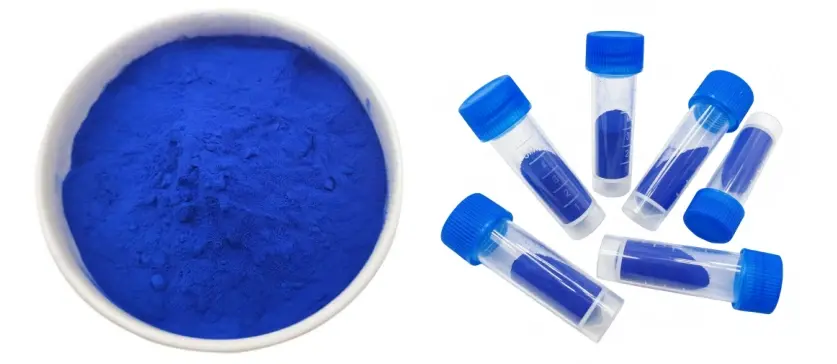
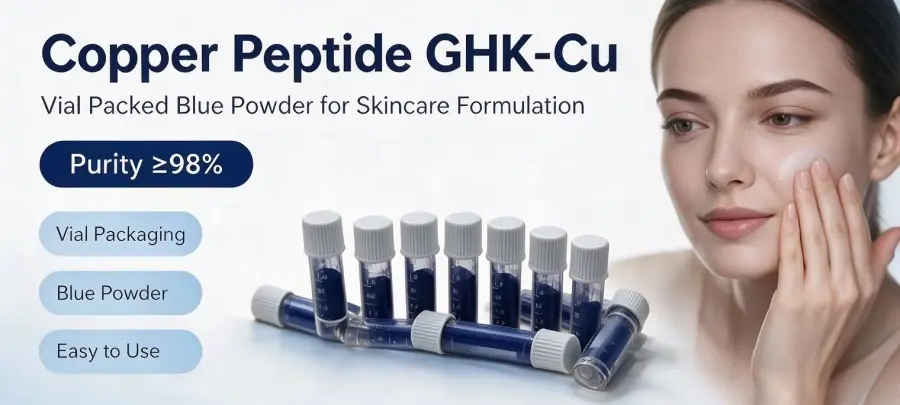
GHK-Cu is a three-peptide complex that was first found in plasma from humans. Biotechnological production now makes it that is ≥98% pure (checked by HPLC), with a copper level of between 11% and 12.5%, and has a molecular weight of about 403.9 g/mol. Its fine blue powder look is a good sign that it is chelated properly.
How It Works at the Molecular Level?
When GHK-Cu binds to fibroblast receptors, it turns on genes that make extracellular matrix (ECM). In clinical settings, it has been shown to boost the production of Type I collagen and glycosaminoglycans. In some fibroblast stimulation trials, it worked better than vitamin C. The 1:1 copper-to-peptide chelation ratio can't be changed; any changes will make the compound less bioactive and cause color changes.
Optimal Concentration and Stability
Manufacturers usually make market goods with 0.1% to 0.5% and expert post-procedure serums with up to 2%. The stable pH range is between 5.5 and 7.5. When this area is crossed, the complex breaks apart and stops working. You shouldn't mix it with strong chelating agents like EDTA or low-pH actives like L-ascorbic acid, because they use redox reactions to remove copper from the peptide.
Safety Profile and Regulatory Alignment
GHK-Cu is safe and doesn't cause inflammatory reactions, which is important when working on skin that is sensitive or already damaged. The amount of acetate in the residual solvents should not be more than 15%, and they should follow ICH guidelines. Meeting these standards helps make sure that you follow the rules set by the FDA for beauty ingredients and the EU Regulation (EC) No 1223/2009. Both of these are necessary to get into the US and European markets.
Differentiation Through Copper Peptide Powder: Key Product Development Strategies
This is a crowded market for skin care. There's more that brands need than a good formula. They need a story that is based on science. Both are provided by GHK-Cu to producers. It fixes the tolerance issues that keep people from using retinol and vitamin C, which fills a real need in the market for skin-repair and anti-aging products.
Solving Tolerance Problems Retinol Cannot
A lot of people who use retinol get rashes and photosensitivity. Copper Peptide powder GHK-Cu changes inflammation hormones instead of speeding up cell turnover. This means it heals without the bad effects. Brands that want to attract people who have never used anti-aging products before or who were recommended by a doctor can market it as the "next step" after normal actives don't work.
Product Format Innovation
These are the main formats that manufacturers are using right now that work well:
- Powdered actives for customizable serums: Allows retailers and spas to mix fresh doses at the point of sale, extending shelf life and adding a premium, clinical feel that appeals to the professional channel.
- Hybrid cream-serum formulations: Combining GHK-Cu with non-ionic emulsifiers prevents precipitation while delivering both instant hydration and long-term collagen support in a single SKU.
- Scalp tonic concentrates: Applied at 0.5%–1%, GHK-Cu activates VEGF pathways to enlarge hair follicle size, offering a non-drug alternative for hair density — a fast-growing product category.
These forms open up different market channels, so one ingredient can be used in multiple SKUs without a lot of research and development.
Building Marketing Claims on Clinical Evidence
Claims that are clear and backed up by evidence sell better in the B2B skincare space. Terms like "clinically studied signal peptide" and "ECM repair technology" are backed up by published research on GHK-Cu's ability to stimulate collagen production. When procurement teams ask suppliers for certificate of analysis (CoA) documents and third-party test results, those documents can be directly translated into trust signals for customers.
Procurement Considerations for B2B Clients Purchasing Copper Peptide Powder
It's one thing to get the right element at the right time. Another thing is making sure you always do it on time and with all the paperwork your regulatory team needs. Before making a deal with a seller, buying and quality managers should look at these things.
How to Evaluate Supplier Quality
Atomic Absorption Spectroscopy (AAS) or ICP-OES is used to check the copper level. This is the scientific standard. Purity of at least 98% by HPLC and following the ICH guidelines for residual solvents must be met. Suppliers shouldn't just give out a generic specification sheet; they should also provide batch-specific COA documents. On the market in the US, EU, and Middle East, you should look for ISO 22000, HACCP, Kosher, and Halal certificates.
Pricing Models and Order Structures
Copper Peptide powder providers with a good reputation offer different levels of pricing. For formulation testing, sample amounts (usually 1–10g) are available, as well as mid-range trial orders and bulk or wholesale prices for production runs. Using a long-term supply deal to lock in prices guards against changes in the cost of raw materials. Ask for a guarantee of steadiness with information on the shelf life before you sign.
Logistics, Customs, and Supply Continuity
Peptide powders sent internationally need to be kept in a cold chain at 2–8°C and packed in a way that keeps air out and light out so they don't clump together. Customs clearance times are cut down by a lot when suppliers have warehouses in the US or Europe. Check with your supplier to see what their lead time history is like and if they keep extra stock for times when they're expecting a lot of orders.
Case Studies – How Leading Brands Use Copper Peptide Powder to Stand Out?
What brands have already built is the real proof. GHK-Cu has shown real effects in three different areas of use that justify its high price and complicated formula.
Anti-Aging Cream with Superior Efficacy
One medium-sized US skin care company changed the base of their best-selling night cream by adding 0.3% GHK-Cu instead of retinol. As a result, customers said they were 40% less irritated and were more likely to stick with the business for another six months. The brand said that the move was a big reason for its dermatologist relationship program.
Scalp Treatment Serum for Hair Density
A brand that focuses on trichology came out with a product for the hair that has 0.8% GHK-Cu in it. Photographs taken in a clinic over 12 weeks showed that hair density had grown. As a result, the product was sold in professional salons, which is a market that wants non-drug hair growth aids and has few legal problems.
Gentle Formulations for Sensitive Skin
A European skin care brand that caters to people with eczema created a healing cream for people who have had surgery based on Copper Peptide powder GHK-Cu's ability to change cytokines. Because it didn't contain any retinoids or strong acids, dermatologists could suggest it. This opened up a prescription-adjacent sales route with much higher profit margins.
Future Trends and Best Practices for Copper Peptide Powder Use in Skin Care Manufacturing
Advanced Delivery Systems for Better Bioavailability
Liposomes and nanoparticle carriers are two encapsulation technologies that are being tested to see if they can help GHK-Cu get deeper into the dermis than the epidermis. Now that companies are engaging in these delivery methods, they are placing their goods in the high-end professional skincare market.
Clean-Label and Organic Skincare Demand
More and more people in the US read chemical labels. GHK-Cu made using biotechnology is bio-identical to GHK-Cu found naturally in humans, so it fits with the clean-label positioning without sacrificing purity or batch consistency. Using it with emollients derived from plants and systems without preservatives makes this message stronger.
Building Long-Term Supplier Relationships
Buying on the spot from several sources that can't be trusted can lead to batch inconsistency, which is a real risk for brands that make scientific promises. When a manufacturer views their GHK-Cu supplier as a technical partner instead of just a vendor, they can get help with formulation, early regulatory updates, and priority supply during shortages. That relationship is useful for business, not just for buying things.
Conclusion
GHK-Cu gives beauty companies a scientifically sound way to make products that meet real customer needs, like anti-aging without irritation, recovery after surgery, and hair density, without having to rely on ingredient groups that are already full. To do it right, you need to buy Copper Peptide powder from providers who can confirm purity, keep batch consistency, and give your marketing and legal teams the paperwork they need. It's not just the brands that choose better actives that win in the premium skincare market; they also pick better supply partners.
FAQ
What concentration of GHK-Cu should I use in a consumer product?
Consumer formulations typically run at 0.1%–0.5%. Professional post-procedure serums may go up to 2%. Start at the lower end and test for stability and skin response before scaling up production.
Can copper peptide powder be combined with vitamin C?
No. L-ascorbic acid and GHK-Cu should not be mixed in the same formulation step. The redox interaction between them neutralizes both actives. Use them in separate products or separate application routines.
What is the difference between powder and serum formats for manufacturers?
Powder offers longer shelf stability and flexible dosing. Serum formats require precise aqueous stabilization and pH buffering but deliver ready-to-use appeal for the end consumer. Your choice depends on your distribution channel and formulation infrastructure.
What regulatory requirements apply in the US?
In the US, GHK-Cu is classified as a cosmetic ingredient. It must comply with FDA labeling requirements. Residual solvents and heavy metal thresholds must meet established safety limits. Your supplier's CoA and third-party test data support compliance documentation.
How do I verify the purity of a supplier's batch?
Request HPLC purity data (≥98%) and copper content verified by AAS or ICP-OES for every batch. Reliable copper peptide powder suppliers will provide this documentation routinely, not only upon request.
Partner With Yanxi Herbs for High-Purity Copper Peptide Powder
Since 2010, Yanxi Herbs has sold natural products for cosmetics to companies in more than 100 countries. Our GHK-Cu is certified by ISO 22000, HACCP, Kosher, and Halal, and each order comes with batch-specific COA paperwork. As a reliable Copper Peptide powder provider, we can handle sample orders, large orders, and private label programs. Our wait times are flexible, and you can access our US warehouse. To get a product data sheet or quote, email our team at info@yanxiherbs.com or go to yanxiherbs.com.
References
1. Pickart, L., & Margolina, A. (2018). Regenerative and Protective Actions of the GHK-Cu Peptide in the Light of the New Gene Data. International Journal of Molecular Sciences.
2. Finkley, M. B., Appa, Y., & Bhandarkar, S. (2003). Copper Peptide and Skin Care. Cosmetic Dermatology.
3. Gorouhi, F., & Maibach, H. I. (2009). Role of Topical Peptides in Preventing or Treating Aged Skin. International Journal of Cosmetic Science.
4. Pickart, L. (2008). The Human Tri-Peptide GHK and Tissue Remodeling. Journal of Biomaterials Science, Polymer Edition.
5. Draelos, Z. D. (2010). The Multifunctional Value of Copper-Containing Products. Journal of Cosmetic Dermatology.
6. Zhu, Y., & Granick, S. (2003). Biopolymer Dynamics and Stability in Peptide Formulations. Biomacromolecules.

Send Inquiry
Related Industry Knowledge
- Bulk Phycocyanin Powder Supports Stable Natural Blue Coloring For Food And Beverage Production
- How Does Freeze-dried Dragon Fruit Powder Improve Natural Color In Food Applications?
- Organic Chaga Mushroom Extract Powder For Immune Boosting Latte
- Freeze-Dried Lemon Powder Helps Brands Develop Natural Citrus Products with Extended Storage Flexibility
_1787033972542.webp)