
Red Yeast Rice Extract Powder for Fermented Ingredient Blends and Commercial Food Processing
Nov 10, 2026
Red Yeast Rice Extract Powder suits fermented ingredient blends and commercial food processing when buyers need a standardized, easy-to-dose material with clear documentation. It comes from rice fermented with Monascus, then dried, milled, and tested for monacolin K by HPLC. Compared with plain red yeast rice, the extract gives formulators tighter control over potency, particle size, and color. In this guide, I share how it is made, what to check on a certificate of analysis, how it behaves in blends, and how to choose a supplier. I also cover US regulatory points, so your team can plan with fewer surprises.
Why Red Yeast Rice Extract Powder Is Used in Commercial Food Processing?
Understanding the Different Formats
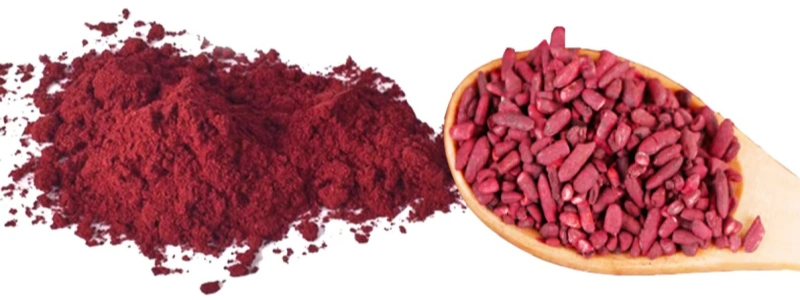
When people buy something, they often mix up four types. Fermented red rice is the whole grain after it has been fermented. Ground rice that hasn't been changed much else is used to make Red Yeast Rice Powder. The stuff is very pure and dried to a certain level. Consumer products come in finished packages. We make our Red Yeast Rice Extract Powder from whole rice grains that have been fermented. It is a fine red to purple-red powder. Picking the right style early on will save you time when you're sampling. More than any other type, extract powder lets you make a premix, fill capsules, or press tablets. When pills are used, the amount or the base can't be changed.
Why Manufacturers Choose an Extract?
Extract powder is used for control by companies that make things. R&D teams don't have to guess how much to put in each serve when the monacolin K range is set. It takes up more room in a mix to use whole rice powder instead of concentrated powder. This can help you save space on the truck and in storage. Powder that flows easily through hoppers and fillers stops less often, and fine particles mix more evenly. For vitamins, useful foods, powdered drink mixes, and items with your own brand name on them, these traits are important. We use HPLC to find out that our grade has between 0.4% and 4% monacolin K. This way, you can match the strength to the serving size instead of having to change the recipe to fit the raw material.
What Purchasing Teams Ask For First?
The people who buy things and check the grade always ask me the same things. On top of that, they want to know the microbiological limits, the results for contaminants, the active level, the test method, and a certificate of analysis that is unique to the batch. They also asked how the food will be packed, how long it will last, how to export it, and how long the lead time is. There are 25 kg drums, 1 kg bags, and 5 kg boxes of Red Yeast Rice Extract Powder. One to three business days after payment is received, the goods are ready to be sent out. You could get some for free. Quality teams can finish source files faster with the help of our ISO 22000, HACCP, FDA Registration, Kosher, and Halal certificates.
How Red Yeast Rice Extract Powder Is Made, and What It Contains?
From Rice to Powder
The first step is to choose the right rice. After that, fermentation takes place with a chosen Monascus strain, such as Monascus purpureus. After fermentation, the material is taken out, concentrated, dried, milled, and sieved. There is only one pass through an 80-mesh sieve for our powder. This makes it smooth and fine, great for mixing. Each step changes what will happen in the end. Time of fermentation, temperature, humidity, pH, and oxygen exposure are some of the things that can change color, yield, flavor, and the profile of active compounds. Because of how easily things can change, suppliers need to write down control points and test while the work is being done. These checkpoints tell you how stable your next ten batches will be, so you should ask any provider to explain them.
Active Compounds and Pigments
For most people who buy Red Yeast Rice Extract Powder, monacolin K is the one they want to find. No changes were made to the original sentence, as it is not part of the National Center for Complementary and Integrative Health's language. There are also natural acids, pigments, and sterols in fermented rice. A study from 2012 in the journal Applied Microbiology and Biotechnology talks about tints from Monascus and how fermentation changes them. This is the reason why the color might be different from one seller to the next, even if the monacolin K number looks the same. Every time you get a certificate, make sure it shows all of the monacolins in the sample, not just some of them. It is not possible to switch the numbers.
Why Potency Is Not the Only Specification?
It's not always true that an item with a higher monacolin K number is better for a project. You can tell how the powder will work in a finished product by its color, smell, taste, and how well it dissolves or spreads. Native oils don't mix well with water either, so liquid goods may need a grade that does mix with water or some other way to protect them. As I always say, test samples in the same way that your real product will be used. Our description says that the powder helps keep cholesterol levels and heart health in check. Before it goes on a label, that kind of language has to be checked for each market. Also, your materials should never say they can treat diseases.
Red Yeast Rice Extract Powder Specifications and Quality Evaluation
Our Standard Specification
This is the standard piece of information we give you. Monacolin K, which can be found in amounts between 0.4% and 4% by HPLC, is the active ingredient. The plant source is fermented rice. When it dries, less than 5 percent is lost. The same is true for ash. Heavy metals are present at less than 10 parts per million. Mold and yeast have less than 100 cfu/g, and the plate count is less than 1,000 cfu/g. If you store sealed packs the right way, they will last for 24 months. Your quality team will know exactly what they can and cannot accept with these limits. Before you place your order, please let us know the exact grade you need for your project. If it needs a different monacolin K level, please let us know.
How to Read a Certificate of Analysis?
It's only helpful if the analysis report looks like your lot. Review the real data, the acceptable ranges, the test method, the lab, and the batch number. Forms that are blank and don't have a batch number don't tell you much. Make sure you know what units are being used when you ask for HPLC data on monacolin K. For more important projects, send a sample that has been kept alive to a different lab. The amount of monacolin in different store-bought Red Yeast Rice Extract Powder products was found to be very different in a study that came out in 2010 in the Archives of Internal Medicine. Some of them had citrinin in the study as well. People should check each lot as well, not just the sticker, for this reason.
Safety and Purity Checks
I'd like to suggest four checks that go beyond effectiveness. The first is citrinin, a mycotoxin that some kinds of Monascus can make. You should still check each batch report to make sure that our entry is correct and that there is no citrinin residue or strong fermentation control. The second is heavy metals, since rice can pull them up from the ground. The third is what microbiology can't do. In the fourth case, synthetic lovastatin could be added to the drug to make it stronger. It is possible to tell the difference between natural and man-made sources by checking for carbon-14. By EU) No 212/2014, the EU says that red yeast rice food supplements can only have 100 µg/kg of citrinin. This is a good rule for people who want to export.
Formulation and Format Comparison for Fermented Blends
Extract Powder Versus Other Formats
Red Yeast Rice Extract Powder, capsules, and whole fermented rice all have different goals. Brands can't make many changes to capsules since they are already made. However, it is harder to get the right amount of whole fermented rice powder because it changes more from batch to batch. In the middle is the extract powder. It checks the monacolin K level of capsules, tablets, sachets, drink mixes, and premixes that you put in it. Before you decide, you should look at the total cost, strength control, dosage-form freedom, certification scope, minimum order quantity, and certification scope of both standardized and non-standardized materials. We will help you find a grade if you tell us what you want to make.
Blending and Particle Behavior
Being even is most important in low-dose blends of Red Yeast Rice Extract Powder. Which particles spread the active evenly through a mix depends on how fast the flow is going and how dense the mass is. If the label says a carrier, it must be able to mix well with a powder that passes through an 80-mesh sieve. Pilot-scale mixing tests check to see if a blend breaks up when it's moved. You should check for monacolin K in samples from the top, middle, and bottom of a batch. If you want to choose the strength, look at the serving size instead of the price per kilogram. A better grade may cost less per dose.
Color, pH, and Stability
Red yeast rice extract gives the food its color and may give it a slightly sour taste. Do color tests early on because even small amounts can change the color of light things. You should check the pH level, the mixing temperature, and how well it works with minerals, probiotics, proteins, plant extracts, and sweeteners. Keep an eye out for sedimentation when working with liquids because native extracts don't mix well with water. One way to make sure monacolin K is safe is to measure it after it has been handled and kept. To use the powder as a color in the US, you should first have a lawyer look over the FDA's rules on color additives. Only then should you start making more.
Choosing a Supplier and Moving to Long-Term Supply
Supplier Checklist
If you want to get quotes, you should know what you want, who you want to buy from, how strong it is, what documents you need, the minimum order quantity, and when you need them. Then compare suppliers on production capacity, HACCP or GMP systems, export experience, traceability, change control, and third-party testing. Yanxi Biotech has been in business since 2010 and sends natural goods to over 100 different places. ISO 22000, HACCP, SGS, Kosher, and Halal are some of the certifications we have. There is also an FDA registration for our Red Yeast Rice Extract Powder. When you compare prices, look at the active content and the total cost, which includes testing, freight, duties, and bad batches. A fair quote that passes the audit costs more than a low quote that doesn't.
US Regulatory and Safety Review
If you live in the US, you need to be extra careful. There are some red yeast rice products that the FDA says can't be sold because they have the same structure as lovastatin and have a lot of monacolin K. There are safety worries about how it might affect the liver and muscles, as well as how it might combine with some medicines. Because of this, labels need to be carefully read and contain warnings. Reg (EU) 2022/860 in the EU says that food additives can't have more than 3 mg of monacolins per daily dose. People who sell things outside of the EU need to know this. Natural things can still make you sick. Before you start, you should have your regulatory lawyer look over the classification, the levels that are allowed, the claims, and the import papers.
From Sample to Annual Supply
A sample request and all the papers that go with it can help you get off to a good start. Next, try the effects on volatility, strength, and stability in the lab and on a small scale. Also, make sure that the effects are well regulated. After making sure all the details and packaging are correct, a test order can be placed before making plans for the whole year's supply. In stock, we have free samples and materials, and we store things close to home in the US and Europe. For OEM and private-label projects, we help with unique specs, planning the package, trial production, and scaling up. As a purchasing manager, you can focus on lead time and total cost. As an R&D team, you can focus on active retention and dispersibility. As a distributor, you can focus on audit-ready files.
Conclusion
Red Yeast Rice Extract Powder can be used in fermented mixes and industrial processes because it is an ingredient and not a good in and of itself. With extract powder, you can choose from more doses and get more measured monacolin K than with whole fermented rice or pills. Checking the fermentation process is the first step toward consistency, which can be seen in the analysis report for each batch. This record checks for limits on microbial growth, citrinin, heavy metals, and effectiveness. Pilot tests are important because the strength, color, pH, and stability of the particles affect how the formulation works. Since monacolin K is the same as lovastatin, all projects are influenced by rules from the US and EU about how to classify, dose, and make claims. You need clear specs, samples that you've tried, and test data that you can trust in order to make a good purchase.
FAQ
Is red yeast rice powder the same as extract powder?
No, ground fermented rice is what Red Yeast Rice Powder is made from. It is possible to measure and write down the monacolin K level of Red Yeast Rice Extract Powder because it is standard and concentrated.
What monacolin K level should I choose?
There isn't just one level. You can choose based on the number of servings, the people you want to serve, and the laws in your area. Our powder's HPLC range is between 0.4% and 4%, and our staff can help you find the right grade.
How can I verify purity?
Check out the test methods and ask for a COA that is unique to the batch. Then, send the samples you want to keep to a different lab for citrinin, heavy metals, and microbiology tests.
Can I use it in beverages?
It's possible. Native extracts don't mix well with water, so find out how stable and dispersed they are and whether you should use a grade that mixes with water or an encapsulation.
How should I store it?
Don't open it, and store it the right way. It'll last for two years.
Request a Red Yeast Rice Extract Powder Specification and Sample From Yanxi Herbs
Yanxi Herbs can send you a copy of their specification sheet, a recent COA, and a free sample of their Red Yeast Rice Extract Powder so that you can try it out. Our stock is always full, and we send within one to three business days after getting paid. We also do both OEM and private-label jobs. Let us know what kind of strength, market, and package you want to use. You can email info@yanxiherbs.com or visit yanxiherbs.com to learn more.
References
1. Annals of Internal Medicine, 2009. Red Yeast Rice for Dyslipidemia in Statin-Intolerant Patients.
2. Archives of Internal Medicine, 2010. Marked Variability of Monacolin Levels in Commercial Red Yeast Rice Products.
3. European Journal of Preventive Cardiology, 2017. Variability in Strength of Red Yeast Rice Supplements Purchased from Mainstream Retailers.
4. Applied Microbiology and Biotechnology, 2012. Monascus Pigments.
5. Official Journal of the European Union, 2014. Commission Regulation (EU) No 212/2014 on Citrinin in Food Supplements Based on Rice Fermented with Red Yeast Monascus purpureus.
6. Official Journal of the European Union, 2022. Commission Regulation (EU) 2022/860 on Monacolins from Red Yeast Rice.

Send Inquiry
Related Industry Knowledge
- High Purity Butterfly Pea Flower Extract Powder For Functional Beverage Production
- Freeze-dried Dragon Fruit Powder for Vibrant Natural Color and Clean Label Formulations
- How Can Beet Powder Be Used In Natural Color And Sports Nutrition Product Development?
- Vegan Chlorophyll Powder For Internal Deodorant Formulations