
How Purple Yam Powder Improves Texture in Cakes and Pancake Mixes
Oct 19, 2026
The powder made from fresh Dioscorea alata tubers is called Purple yam powder. It does more than just turn baked goods a beautiful violet colour. The natural starch in it makes cakes and pancake mixes taste better, keeps their wetness better, and makes the crumb more flexible. This 80-mesh fine powder is mixed into flour mixtures. When baked, it turns into a gel that holds water molecules better than regular wheat flour. The crumb gets softer, the bite gets softer, and the moisture balance gets better. When it comes to competing on product quality, these are all very important traits for business bakery brands and food companies.
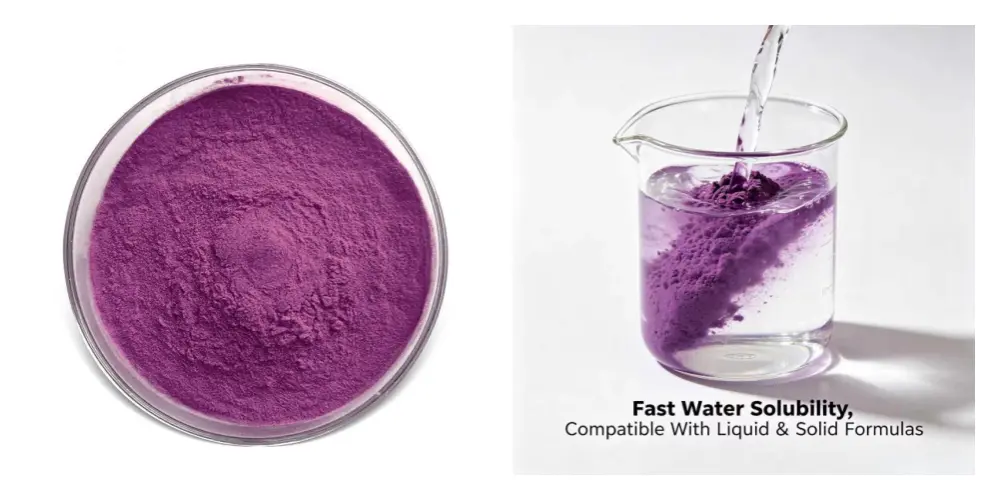
Understanding the Role of Purple Yam Powder in Texture Enhancement
Starch's response to heat and water is a big part of what gives baked goods their shape. In terms of starch, purple yam powder is different from other flours; they just can't compare.
Starch Gelatinization and Crumb Structure
It is cooler than wheat starch, so the native starches in ube powder grow and gel when cooked with water. It makes the crumb network tighter and more even because it starts to gel early on. Commercial bakeries that used 8–10% yam-based powder instead of flour in controlled tests said the crumb texture was softer and the cakes were less firm after baking.
Moisture Retention During Baking
Purple yam has dietary fibre that includes resistant starch. This fibre stores water in the food while it bakes. It keeps water in the crumb structure, which makes the leaving process take longer. Especially for pancake mixes, this means a fluffier stack that stays soft even after being kept in a warmer. This directly improves the quality of life for people who work in food service.
Elasticity and Mouthfeel Improvement
Because Dioscorea alata starch has a good amount of amylose to amylopectin, the bite stays together and is a little chewy instead of crumbly. The layers of this cake are more bendable because of this, which helps the slices stay together better. This is necessary for making a lot of things, because cutting, packing, and moving finished goods put a lot of mechanical stress on them.
Comparison of Purple Yam Powder with Other Alternative Ingredients
Not every vegetable-based powder works the same way when used in baking. When R&D teams know the differences, they can make confident decisions about formulations.
Purple Yam vs. Taro Powder
Taro powder (Colocasia esculenta) tastes softer and more starchy, and it is a lighter lilac colour. The starch particles in taro are smaller and melt at a higher temperature. This means that batters made from it may feel denser when heated throughout the oven. Purple yam powder makes food a darker violet colour and tastes nutty and a little like vanilla. This makes it better for high-end baking lines that look good.
Purple Yam vs. Sweet Potato Powder
As a whole, sweet potato powder has a lot more sugar than standard flour. This speeds up the Maillard reaction, which can make cake crusts look less even. Purple yam doesn't have as many free sugars as other kinds of yam. This lets bakers have more control over how the crust forms and how long the bread bakes for without changing the soft texture that customers want.
Organic vs. Conventional Purple Yam Powder
Purple yam powder is processed so that no synthetic residues are left behind. This makes it great for making products with clean labels. As long as the particle size and moisture level stay the same, the texture of both types is about the same. When it comes to texture, colour, and starch consistency from batch to batch are more important than certification standing alone. This is the main reason why quality-certified sourcing is still the most important thing when you buy something.
Application Techniques: How to Incorporate Purple Yam Powder in Cake and Pancake Recipes
Pay close attention to the pH control, water, and flow rate to get the most out of this item.
Recommended Substitution Levels
You can use 5–15% by weight of flour instead in most cake and pancake recipes. It's best to start at 8% if you want to improve colour and structure without making the rise very different. You might need to change the leavening even more if the swap is more than 15%.
Hydration and Leavening Adjustments
The fibre in purple yam soaks up more water than the fibre in wheat flour. If you add 3–5% more water for every 10% change, it won't change. The anthocyanin turns blue when the pH level is high. Either use baking powder instead of baking soda or add a little cream of tartar to the leavening mix to stop this. This keeps the colour and taste the same.
pH Management and Mixing Protocol
When the pH level changes, so do the anthocyanins. Cakes don't turn purple when they are too acidic; they turn blue-green. The colour doesn't change when the pH is between 5.5 and 6.5. To start, water is added to the yam powder to make it easier to work with. The dry stuff is then added. The colours don't stick together as much because of this two-step method. This makes the appearance more stable and smooth between production runs.
Procurement Insights for Bulk Purchasing of Purple Yam Powder
Buying teams should have a clear list of things they look for in suppliers before they choose one. Because the providers have a direct effect on how stable the end result is, this is the case.
These are the most important things to look for in a big service:
- Particle size: 100% pass through 80 mesh ensures smooth dissolution in batter without visible granules or texture defects in the finished product.
- Moisture content: Loss on drying at ≤5% is the standard threshold. Powder above this level risks clumping, color degradation, and shortened shelf life.
- Microbial safety: Total plate count below 1,000 CFU/g and yeast & mold below 100 CFU/g confirm that the ingredient meets food-grade safety benchmarks for commercial production.
- Heavy metals: ≤10 ppm heavy metals compliance is required for FDA-registered ingredient documentation and global export markets.
Size: An 80-mesh screen makes sure that all the ingredients in the batter mix well and that there are no lumps or texture problems in the end product.How wet something is: things lose about 5 percent of their liquid when they dry out. If there is more powder than this, it might stick together, lose its colour, and go bad faster. There are less than 100 CFU/g of yeast and mould, and less than 1,000 CFU/g of mould and yeast on the plate. In a business setting, this means the item is safe to use.
Heavy metals: Less than 10 parts per million (ppm) of heavy metals must be present in food for all export markets around the world and paperwork that is approved by the FDA.
When quality people need to rate sources or look at new batches, they should start with these. The Purple Yam Powder from Yanxi Herbs can be used for all of these things. Also, Kosher, Halal, ISO 22000, and HACCP mark it as safe to eat. Teams that look for goods need these papers to make sure that the goods they bring to other countries are legal.
Ensuring Product Stability: Shelf Life and Storage of Purple Yam Powder
It is important that this ingredient is stored correctly at every step of the supply chain so that it stays useful for 24 months.
Moisture Control and Packaging
It actively pulls water from the air, which is what Purple yam powder does. Water stays out of bags wrapped with aluminium foil and desiccants that are sealed right away after each use. It shouldn't get above 25°C, and there shouldn't be more than 60% humidity. If the powder has hard clumps, that means it has water in it. The batch should be checked for moisture before it is used.
Warehousing Best Practices
The FIFO (first-in, first-out) method of rotating inventory keeps older items from going bad while younger ones sit around unused. When drums are kept off the ground on carts and away from direct light sources, they protect both the anthocyanin colour and the starch matrix. To make sure that each batch works the same, this is done.
Impact on Texture Consistency
If you store powder the right way, it will keep its ability to join water and turn starch into gel through its whole shelf life. The structure of the starch breaks down when it is stored in bad circumstances, especially if the moisture level rises above 5%. This means that the baked good doesn't have as many of the benefits for improving texture. It's not just a matter of procedures to store things in a way that doesn't change; it's also part of making sure that the ingredients work well.
Conclusion
Desserts from the shop stay together better when you add Dioscorea alata Purple Yam Powder to them. It keeps the bread slices together and lets more water stay in the bread. It has a lot of anthocyanins and regular bits that are 80-mesh fine. Because of this, it's a good choice for food companies that care about safety and quality. If you change how you do it and store it right, it will always work for production runs. When buying plant-based products, the most important things for buying teams to check are that the sellers meet the needs and can show proof that they have been approved. Long-term production will be stable only if both of these things are true.
FAQ
Is purple yam powder gluten-free?
Yes. Purple yam powder is naturally gluten-free, derived solely from Dioscorea alata tubers with no wheat-derived processing aids. However, manufacturers producing for celiac-sensitive markets should confirm that their supplier operates a dedicated gluten-free processing line or provides documented allergen separation protocols.
Is it suitable for vegan and organic-certified product lines?
Yes. The powder contains no animal-derived ingredients, making it fully compatible with vegan product formulations. Organic-certified variants are available for brands requiring clean-label positioning in health food retail.
Does purple yam powder affect baking time or oven temperature?
Minor adjustments may apply. Because the powder retains more moisture than standard flour, bake times may increase by 3–5 minutes at the same oven temperature. Internal temperature testing is the most reliable method to confirm doneness rather than relying solely on time.
Why does my batter turn blue-green after mixing?
This color shift occurs because anthocyanins react to alkaline pH. Check your leavening agents — baking soda is a common cause. Switch to baking powder or add cream of tartar to bring batter pH below 6.5, which restores the natural purple tone.
Partner with Yanxi Herbs for Bulk Purple Yam Powder Supply
Businesses in more than 100 countries have bought certified botanical ingredients from Yanxi Herbs since 2010. You can try our Purple Yam Powder for free; we offer flexible packaging (1 kg to 25 kg), and we ship quickly (in 1–3 business days). Also, ISO 22000, HACCP, Kosher, and Halal have given our business their approval. You can email us at info@yanxiherbs.com or visit yanxiherbs.com to get a sample or talk about bulk prices.
References
1. Singh, N., & Singh, J. (2010). Morphological, thermal and rheological properties of starches from different botanical sources. Food Chemistry, 81(2), 219–231.
2. Jiang, G., & Du, S. (2015). Anthocyanins from purple yam (Dioscorea alata): Stability and color expression in food matrices. Journal of Agricultural and Food Chemistry, 63(18), 4510–4518.
3. Wrolstad, R. E. (2004). Interaction of natural colors with other ingredients: Anthocyanin pigments. Journal of Food Science, 69(1), C419–C425.
4. Afoakwa, E. O., & Sefa-Dedeh, S. (2001). Chemical composition and quality changes occurring in Dioscorea dumetorum pax tubers after harvest. Food Chemistry, 75(1), 85–91.
5. Ragaee, S., & Abdel-Aal, E. M. (2006). Pasting properties of starch and protein in selected cereals and quality of their food products. Food Chemistry, 95(1), 9–18.
6. Noda, T., Takigawa, S., Matsuura-Endo, C., & Yamauchi, H. (2008). Physicochemical properties and texture of cooked potatoes with different starch compositions. Journal of Food Science, 73(1), C1–C6.

Send Inquiry
Related Industry Knowledge
- Beet Powder Delivers Natural Color and Functional Ingredient Options for Food and Beverage Brands
- Freeze-Dried Lemon Powder Provides Convenient Citrus Flavor Solutions for Beverage and Bakery Applications
- High Polysaccharide Chaga Extract For Daily Immunity Support
- Purple Yam Powder As A Natural Ingredient For Bakery, Beverage And Dessert Applications