
Purple Yam Powder: Color Retention in Commercial Food Processing
Oct 21, 2026
Purple yam powder, derived from the fresh tubers of Dioscorea alata, has become one of the most sought-after natural colorants in commercial food manufacturing. Its deep violet pigment comes from anthocyanins—water-soluble plant compounds with both coloring and antioxidant properties. For food and beverage manufacturers working at industrial scale, achieving consistent, stable color across production batches is a persistent formulation challenge. This article examines how this botanical ingredient performs under real processing conditions and what procurement professionals need to know before sourcing it at scale.
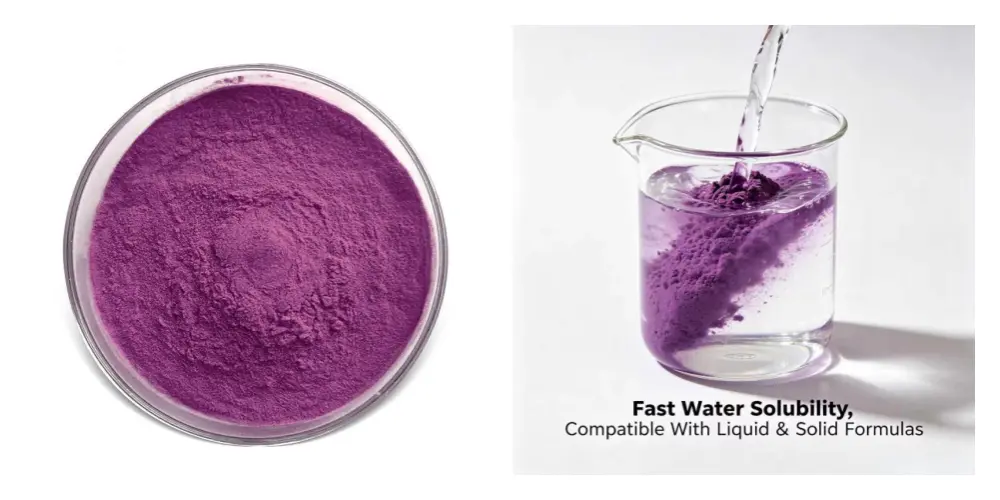
Understanding Purple Yam Powder and Its Role in Food Processing
What Sets It Apart from Similar Powders
Purple root powder comes in different types that work better in business settings. What plant does the purple yam (Dioscorea alata), the purple sweet potato (Colocasia esculenta), and the taro come from? They are all different in terms of color and plant. "Ube powder" and "ube fruit" are often used to refer to the same thing in stores. They both come from the same plant, but how they are treated can change how much anthocyanins they have. The 80-mesh Purple Yam Powder made from 100% fresh tubers keeps more of its color when sprayed dry than when dried in the air.
Compositional Profile and Color Characteristics
The color of this powder comes from anthocyanin, a flavonoid. It changes the color to a deep violet-purple. Besides adding color to food, it also has vitamins, resistant starch, and fiber. According to science, particles with an 80-mesh size that lets 100% of them pass through can spread out quickly in liquids. Soil buildup is a quality issue in dairy and drinks, so this is important.
Why B2B Clients Choose Natural Colorants
Formulators are turning away from man-made colors like Red No. 40 and Blue No. 1 because people want their things to have clean marks. A study from 2023 by SPINS showed that from one year to the next, more than 12% more natural colorants were used in packaged foods in the U.S. Businesses that get their colorants from plants have more control over how the government regulates them and how they sell their goods. This is especially true in places where adding is not allowed. Yes, anthocyanins break down when they stay above 80°C for a long time. When used for baking, the color fades quickly because oven temperatures often go above 160°C. A study in the 2019 issue of Food Chemistry says that cooking anthocyanin makes it break down more quickly. After thirty minutes in hot weather, the color isn't as bright. If you mix the covering at low temperatures or after the food has been cooked, you can cut down on this loss.
Challenges in Color Retention During Commercial Food Processing
Heat Exposure and Pigment Degradation
Anthocyanins degrade when exposed to sustained heat above 80°C. In baking applications, where oven temperatures routinely exceed 160°C, color loss is a measurable issue. Research published in Food Chemistry (2019) confirmed that thermal treatment accelerates anthocyanin breakdown, with color intensity dropping significantly after 30 minutes at high temperatures. Low-temperature mixing or post-bake application strategies can reduce this loss.
pH Sensitivity in Processing Environments
Anthocyanins are natural pH indicators. In alkaline environments—such as batters containing baking soda—the pigment shifts from purple toward blue or grey. This is a practical issue in confectionery and bakery lines where leavening agents are standard. Formulators who substitute baking powder (which is pH-balanced) or add a mild acid such as cream of tartar report better hue retention throughout the bake cycle.
Oxygen and Light Interaction During Production
Prolonged oxygen exposure during mixing and storage accelerates oxidative pigment loss. Similarly, UV light exposure degrades anthocyanin structure over time. For food manufacturers running open-air mixing lines, protective measures—such as nitrogen blanketing during processing or light-barrier packaging—are practical interventions that protect color quality between production and retail.
Optimizing Color Retention Using Purple Yam Powder
Temperature and pH Control in Formulation
Keeping the pH level between 3.5 and 6.0 and the temperature below 70°C are the best ways to keep anthocyanin stable. Sometimes mixes that are a little acidic, like fruit juice mixes, help keep the color stable when they are used in drinks. Formulators may need to add co-stabilizers like citric acid or ascorbic acid when they work with dairy or neutral-pH systems.
Combining with Natural Stabilizers
So, when you mix yam powder with ascorbic acid or rosemary extract, you create a buffer that protects the colors from breaking down too fast. Adding ascorbic acid at levels between 0.05 and 0.1% has been shown to make the half-life of anthocyanin in water-based systems last a lot longer. Supplement firms already use it to make drinks that are high in anthocyanins and stay colored for a long time.
Evaluating Powder Quality Before Procurement
It is important to keep in mind that not all suppliers offer the same particle size or color depth. They should ask for a Certificate of Analysis (CoA) that tells them how much anthocyanin is there, how much moisture is there (≤5%), how much heavy metal is there (≤10 ppm), and how many germs are there (Total Plate Count <1000 cfu/g). Why does the color stay the same from batch to batch? Because of these numbers. When this has been done a lot of times, procurement teams will often ask for a free sample to test in-house before placing large orders.
Procurement Guide: Sourcing High-Quality Purple Yam Powder
Certification Requirements for Global Markets
This is needed for any food business that wants to sell its goods in the US and the EU. A business that makes plant colorants must be FDA-registered and have at least ISO 22000 or HACCP approval in order to sell to people in the U.S. They need proof that it is Kosher or Halal in order to sell it to people in other countries. Yanxi Herbs sells 80-mesh Purple Yam Powder in standard sizes: 1 kg per bag, 5 kg per box, and 25 kg per drum.
Bulk Purchasing Considerations
Before choosing a seller, buying managers usually take a close look at these important factors:
- Lead time: Yanxi Herbs ships within 1–3 working days after payment confirmation, with stock held ready for immediate dispatch.
- Shelf life: 24 months under sealed, cool, and dry storage conditions—critical for long-cycle production planning.
- Minimum order flexibility: Sample quantities are available at no cost, allowing quality verification before bulk commitment.
One to three business days after getting payment proof, Yanxi Herbs ships as long as they have enough stock to do so right away.
The shelf life is 24 months if it is kept in a cool, dry, and sealed space. This is important for planning long-term production.
Assessing Supplier Transparency and Long-Term Reliability
When teams buy things, these standards help them match up the due dates given by sellers with the work they want to get done. This cuts down on running out of stock and the time it takes to reformulate drugs.
Proper Usage and Storage for Maintaining Quality and Color
Application Guidelines Across Food Categories
Purple Yam Powder can be used in a lot of different foods. Stores that make baked goods add 3 to 5 percent by weight of flour to the dough to give it color. Melt the mix in water above 60°C before adding it to drinks or bubble tea. It won't stick. It's easy to mix the powder into sweets and mooncake ingredients without changing their shape. It tastes like a sweet and earthy yam and goes well with easy recipes.
Storage Conditions That Protect Pigment Integrity
Colors work better or worse depending on how they are kept after being bought. The powder can easily take in water from the air since it is hygroscopic. A lot of things are kept in bags that are sealed and have aluminum foil and dry substances inside them. The bags need to be kept below 25°C and less than 60% humidity. This can happen when there isn't a lot of water in the air, but it's usually easy to fix. But if something hard clumps together, it means water got into it, and it's no longer safe.
Inventory Rotation and Packaging Protocols
This method of stocking makes sure that you don't keep old items for longer than they need to be. If a 25 kg drum is opened, people who work in the business should quickly close it up and keep it out of the light. You can be sure that the 24-month shelf life written on the COA is met by following these steps.
Conclusion
It's not a mistake for industrial food production to have uniform color; it means that good ingredients are used, the process is watched closely, and supplies are bought from a reliable company. Purple Yam Powder can be used in many ways by food and drink brands as long as they buy it from a certified company that uses consistent production standards and raw materials that can be tracked. These tips can be used for many things, such as making sure the pH level is correct when baking and keeping anthocyanins safe. They will help the buying and research and development teams figure out how to use this part in their long-term plans to build.
FAQ
Does purple yam powder contain any artificial additives?
No. The 80-mesh powder from Yanxi Herbs is 100% pure spray-dried Dioscorea alata with zero artificial colorants, fillers, or added sugars. It is a clean-label ingredient suited for natural and plant-based product lines.
Why does the color shift to blue-green in some baked goods?
Anthocyanins react to alkaline pH. Baking soda raises batter pH, causing this color shift. Replacing baking soda with baking powder, or adding a small amount of cream of tartar, stabilizes the pH and preserves the purple hue throughout baking.
What is the recommended dosage for commercial applications?
For natural coloring in baked goods, 3–5% by flour weight is the standard starting point. For flavoring applications in beverages or porridge, 10–15% is more typical. Dosage should be adjusted based on the fat content of the matrix, as higher fat levels can mute perceived color intensity.
Is the powder soluble in cold water?
Standard spray-dried powder requires warm water or high-shear mixing for full dispersion. For cold-application systems such as RTD beverages, a pre-gelatinized version may be more suitable. Contact Yanxi Herbs directly to discuss formulation-specific options.
What certifications does Yanxi Herbs hold for this product?
The purple yam powder is certified under ISO, HACCP, FDA Registration, Kosher, and Halal standards—meeting the compliance requirements for U.S., EU, and broader international markets.
Request a Sample from Yanxi Herbs — Your Trusted Purple Yam Powder Supplier
Since 2010, Yanxi Herbs has sold organic plant-based ingredients to companies all over the world that make food, drinks, and supplements. We give away free samples, can pack in different ways, and have all the safety forms you need when you buy Purple Yam Powder from us. Before you make a full purchase, you can try our goods in your own building. Send our team an email at info@yanxiherbs.com or go to yanxiherbs.com to learn more about prices and other things.
References
1. Castañeda-Ovando, A., et al. "Chemical studies of anthocyanins: A review." Food Chemistry, 2009.
2. Patras, A., et al. "Effect of thermal processing on anthocyanin stability in foods." Trends in Food Science & Technology, 2010.
3. He, J., & Giusti, M. M. "Anthocyanins: Natural colorants with health-promoting properties." Annual Review of Food Science and Technology, 2010.
4. Sinela, A., et al. "Anthocyanin degradation during storage of Hibiscus sabdariffa extract and evolution of its degradation products." Food Chemistry, 2017.
5. Lao, F., & Giusti, M. M. "Quantification of purple corn (Zea mays L.) anthocyanins using spectrophotometric and HPLC approaches." Food Analytical Methods, 2016.
6. Fossen, T., et al. "Colour and stability of pure anthocyanins influenced by pH, including the alkaline region." Food Chemistry, 1998.

Send Inquiry
Related Industry Knowledge
- High Purity Butterfly Pea Flower Extract Powder For Functional Beverage Production
- How Can Beet Powder Be Used In Natural Color And Sports Nutrition Product Development?
- Chlorophyll Powder Offers Stable Plant-Based Coloring Options For Food And Beverage Manufacturers
- Freeze-Dried Lemon Powder Helps Brands Develop Natural Citrus Products with Extended Storage Flexibility