
Butterfly Pea Flower Powder for Color-Changing Tea and Drink Mixes
Oct 22, 2026
Butterfly Pea Flower Powder is rapidly becoming one of the most sought-after natural colorants in the food and beverage industry. Derived from the dried petals of Clitoria ternatea, this 100% pure botanical powder delivers a striking deep-blue hue that shifts to purple or pink when pH drops — with zero artificial dyes involved. For B2B buyers in beverage manufacturing, nutraceuticals, and cosmetics, it presents a clean-label solution that satisfies both regulatory requirements and consumer demand for functional, visually engaging products.
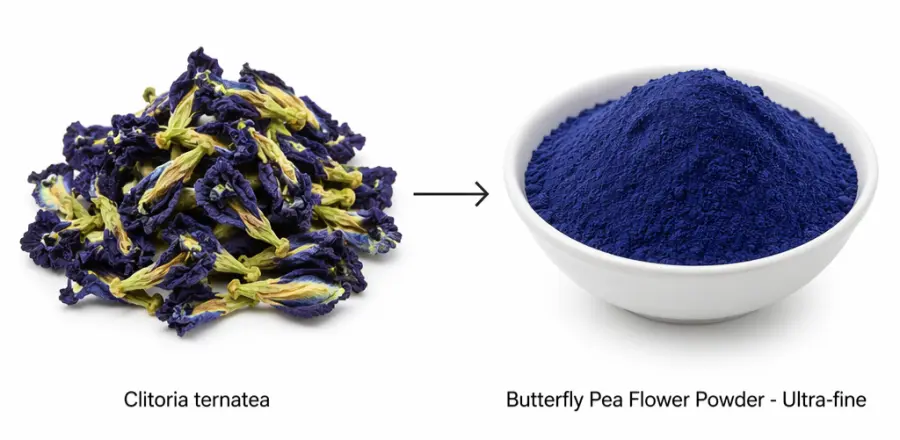
What Is Butterfly Pea Flower Powder and Why Is It Ideal for Color-Changing Drinks?
The Botanical Source and Processing Method
The pretty plant Clitoria ternatea lives in Southeast Asia. The dried petals of this plant are used to make Butterfly Pea Flower Powder. At Yanxi Herbs, the flowers are dried slowly and carefully. Then, machines grind them into a very fine powder with a mesh size of 80 to 200. That part of the ingredient that is bioactive and has delphinidin-based anthocyanins that give it its color stays the same.
The Science Behind pH-Responsive Color Change
Plants and other things can change color because of chemicals they have. The name for them is anthocyanins. The powder turns a bright blue color when it is neutral or alkaline. The pH drops when acidic things like lemon juice or citric acid are added. It changes from blue to pink or red. Tea and drink mixes with clean labels will be loved by people who care about their health. They don't need chemicals that people make.
Industry Applications Across Sectors
There are three main types of work that use this part. Because it doesn't change when hot or carbonated, it's used to make amazing teas, craft drinks, and colored, useful waters. Proanthocyanidin is found in nutraceuticals. It is an antioxidant that is good for brain health. When mixed with soaps and emulsifiers, it doesn't change. You can use it to add color to shampoos, masks, and serums.
Benefits and Considerations for B2B Clients: Applications, Nutrition, and Safety
Functional and Nutritional Value
Plant Clitoria ternatea makes it, and it has a lot of anthocyanins, which are good for you. It was found that the anthocyanins in butterfly pea flowers are very good at getting rid of free radicals. This was published in 2021 in the journal Food Chemistry. That is, they should be used in vitamins and drinks that are good for you. That is, the ingredient isn't just pretty; it makes healthy foods work better.
Clean-Label and Regulatory Standing
In 2021, the FDA said that butterfly pea flower juice could be used to color some drinks and foods. It is a better clean-label choice than FD&C Blue No. 1 because the government has approved it. It can be used by businesses that want to sell in the EU and the US because it is natural and doesn't pose the same health risks as fake colors. Brands can be more honest on their labels, which makes people trust them more.
Safety, Dosage, and Quality Parameters
One gram has a lot of bacteria, but only a few hundred are yeast and mold. In other words, Butterfly Pea Flower Powder from Yanxi Herbs is very safe to use. Very little heavy metal is present—less than 10 parts per million. It gives food a bright color and a light, neutral to spicy taste that doesn't get lost in other flavors if you use the right amount, which is between 0.05% and 0.5% by weight. It stays at 5% for both the amount of ash and the amount that is lost when it dries. This makes sure that the item works the same way every time it is made.
How to Select the Best Butterfly Pea Flower Powder for Your Business Needs
Certification and Compliance Documentation
Before you even look at their goods, make sure that any Butterfly Pea Flower Powder providers you are thinking about have all the right licensing. Yanxi Herbs is Kosher, Halal, FDA-registered, and ISO 22000 Certified, so you can trust it. It can be used by people in North America, Europe, the Middle East, and the Asia-Pacific region. People in charge should always ask for a recent Certificate of Analysis (COA), records of microbe tests, and heavy metal analysis results before they buy big things.
Specification Verification and Potency Assessment
Not every powder made from plants works the same. People should look at the thread size when they buy flowers. It has a sieve with 80 to 200 meshes that lets everything through. The size of the mesh determines how well the herbs break up and how the colors mix in liquids. The seller should give you the HPLC test results so you can see what the active ingredients are and how much flavonoid there is. Color brightness can tell you a lot about the quality of something when it's not being used much. Fillers that are used to make materials weaker, on the other hand, can fade colors over time.
Pricing, Volume, and Supply Chain Logistics
Large companies must always have enough. Yanxi Herbs always has stock on hand and ships within one to three business days of getting paid. They package them in different ways, like 1 kg per bag, 5 kg per box, and 25 kg per drum, because they can make different amounts of things. You can check them out for free first. We can get things to you faster and with less risk when you sign long-term deals for high prices and logistics help, like parking in the US and Europe.
How to Incorporate Butterfly Pea Flower Powder into Your Product Line
Formulation Basics for Beverage Applications
You need to control the pH of the end mix and the amount of powder to liquid before you can get even color. To get a clear blue color in drinks that are mostly water, start with 0.1% to 0.3% by weight. When citric acid, lemon juice, or hibiscus are added, the color slowly changes to pink and purple. There's no need for emulsifiers since the powder itself breaks down in water. It's easy for it to spread out in most liquids. You can now make useful drinks like water, tea mixes, and lemonade with less work.
Scalable Production and Batch Consistency
When the particles are between 80 and 200 mesh, the color can stay the same across large amounts. Anthocyanin stays whole during delivery cycles because it can be stored for 24 months in a dry, sealed space away from UV light. Powders that are warmer than 45°C start to break down, like Spirulina Blue. This one, on the other hand, is much better because it stays stable up to 120°C. Firms that use UHT or pasteurization will find this useful.
Addressing Color Stability Challenges
The color fades quickly with natural dyes, which is a bad thing. The anthocyanin doesn't break down quickly as long as the item is kept below 25°C, tightly packed, and away from UV light. To keep the color in a stable range, the recipes must also have stable pH levels. An antioxidant called ascorbic acid can be added to powdered drink mixes to help the colors last longer without changing the way the clean-label looks.
Conclusion
There is only one natural dye that looks good, is good for you, and has been approved by the government. It is Butterfly Pea Flower Powder. It can be used to make drink mixes, personal care items, craft drinks, and teas that change color, among other things. It can help with many product development goals at the same time. Business-to-business buying teams need to find a source that can meet their needs and back up claims of quality so that they can keep getting what they need. They help the brand's name and the quality of the product last for a long time.
FAQ
How does it compare to Spirulina Blue in heat stability?
Butterfly Pea Flower Powder stays the same color even after being steamed or cooked at almost 120°C. Spruce Blue (phycocyanin) doesn't work on things that have been burned because it breaks down above 45°C. Butterfly pea is the best choice for technology if a business makes lines for drinks that are kept at a high temperature or near room temperature.
Is the color change in finished products reversible?
Yes. The anthocyanins tell you when the pH level is too high or too low. You need to add baking soda to a recipe that is too acidic to make it less acidic. If you use this property, you can make drinks where the person who wants to use them can add something acidic. A lot of people make drinks in a very different way.
What certifications should buyers verify?
Look for proof of at least ISO 22000 or HACCP to be sure the food is safe. If you want to sell to Kosher or Halal shops, you also need a letter from the FDA. Make sure you always get a new COA that shows how many bugs were found, how the heavy metal tests went, and how to spot anthocyanins.
Does the powder comply with US FDA regulations?
Yes. In 2021, the FDA said butterfly pea flower juice could be used to color some foods and drinks. Now that Yanxi Herbs is on the FDA's list, it's easier for goods from China to get into the US.
What is the recommended shelf life and storage condition?
For 24 months, keep it cool, dry, and away from direct UV light. Be sure to cover it and keep it that way. Anthocyanins lose their color more quickly when they touch water, air, or UV light.
Partner with Yanxi Herbs — Your Trusted Butterfly Pea Flower Powder Supplier
Yanxi Herbs has sold pure plant-based goods to companies in more than 100 countries since 2010. Butterfly Pea Flower Powder that we sell is Kosher, Halal, and okay with the FDA, HACCP, and ISO 22000. Tests are free, and your order will be sent in one to three business days. Talk to our staff to get prices on large orders, help with recipes, and more. Send us an email at info@yanxiherbs.com or visit yanxiherbs.com right now to get your sample.
References
1. Paengkoum, P., & Buranawit, K. (2021). Anthocyanin profile and antioxidant activity of butterfly pea flower (Clitoria ternatea). Food Chemistry, 340, 127951.
2. U.S. Food and Drug Administration. (2021). Color Additive Status List: Butterfly Pea Flower Extract. FDA Official Publication.
3. Oguis, G. K., Gilding, E. K., Jackson, M. A., & Craik, D. J. (2019). Butterfly pea (Clitoria ternatea): A cyclotide-bearing plant with applications in agriculture and medicine. Frontiers in Plant Science, 10, 645.
4. Nair, V., Bang, W. Y., Scovronski, A., & Bharat, S. (2020). Functional properties of anthocyanins from Clitoria ternatea in food applications. Journal of Agricultural and Food Chemistry, 68(15), 4371–4381.
5. International Food Ingredients Council. (2022). Clean-Label Colorants: Market Trends and Regulatory Update. IFIC Annual Industry Report.
6. Grand View Research. (2023). Natural Food Colors Market Size, Share & Trends Analysis Report. Grand View Research Market Intelligence.

Send Inquiry
Related Industry Knowledge
- How Can Bulk Fo-Ti Extract Powder Help Brands Expand Plant-Based Ingredient Product Portfolios?
- Hyaluronic Acid Powder Bulk Helps Cosmetic Manufacturers Develop Hydrating Serums, Masks, and Anti-Aging Product Lines
- Why Do Manufacturers Choose Stevia Extract Powder for Formulations?
- Stevia Extract Powder Helps Create Clean-Label Food and Beverage Products