
Freeze-Dried Dragon Fruit Powder for Smoothie and Yogurt Formulations
Oct 21, 2026
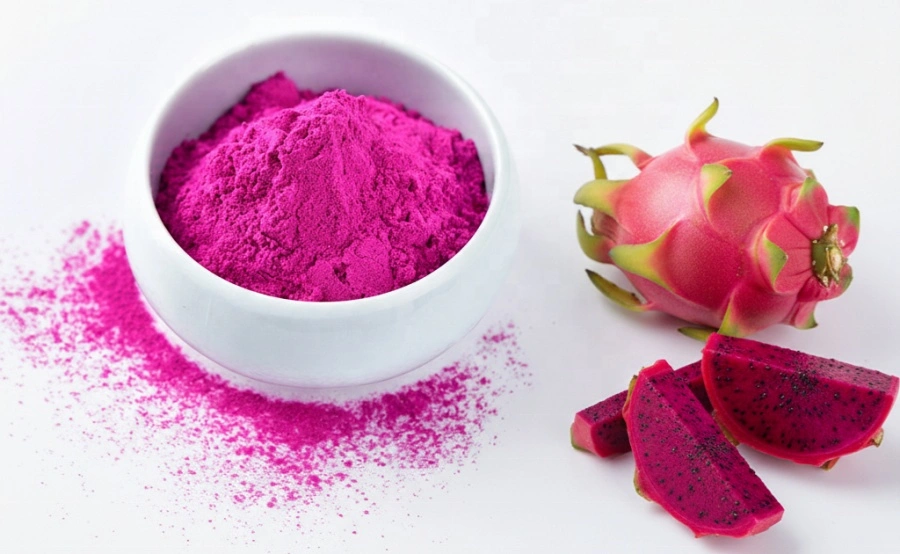
If you're sourcing ingredients for smoothie blends or yogurt products, Freeze-dried dragon fruit powder deserves a close look. This purple-red fine powder captures the full nutritional profile of fresh pitaya — natural betalains, vitamin C, dietary fiber, and antioxidants — without added sugars or preservatives. At 60–80 mesh, it dissolves readily into cold liquids and dairy bases, delivering consistent color and authentic tropical flavor. For B2B buyers across food manufacturing, nutraceuticals, and functional beverage sectors, this guide covers everything from production science to procurement practice.
Understanding Freeze-Dried Dragon Fruit Powder
How the Freeze-Drying Process Works
Lyophilization, which is sometimes called "freeze-drying," removes water without using warm air. At -40°C, fresh red dragon fruit is frozen. It is then put under a vacuum to melt the ice right away. The main parts of a fruit that give it color, vitamins, and taste don't change much because its cells stay together. This makes a powder that doesn't go bad, has less than 3% water, and has a water activity below 0.3. If you store it right, it will last for 24 months.
Freeze-Dried vs. Spray-Dried: A Meaningful Difference
Dragon fruit powder that has been freeze-dried or spray-dried is available. Spray-dried fruit needs helpers like maltodextrin to turn into a powder because it needs a lot of heat to do so. Vitamin C and betacyanins are two acids that don't like heat very much. This really breaks them down. When you freeze-dry fruit, no heat or movement is used, so the fruit you get is clean. Food Chemistry did a study that showed freeze-dried fruit powders keep a lot more vitamins than spray-dried fruit powders.
Nutritional Profile Worth Knowing
The vibrant pink colour of Freeze-dried Dragon Fruit Powder comes primarily from betacyanins, naturally occurring pigments found in red dragon fruit. In addition to its distinctive colour, freeze-dried Dragon Fruit Powder can contribute dietary fibre and other naturally occurring nutrients, although its nutritional composition depends on the raw material and processing method. Freeze-drying helps remove moisture at low temperatures, which can support the retention of certain heat-sensitive compounds, but the actual levels of pigments and nutrients should be confirmed through product-specific testing. For food manufacturers seeking consistent colour and ingredient quality, freeze-dried Dragon Fruit Powder offers a convenient format for use in beverages, bakery products, confectionery, and dessert formulations. Yanxi Herbs can be considered a potential supplier, with buyers advised to verify the current specifications and batch documentation before placing an order. For example, if a supplier reports yeast and mould counts below 100 CFU/g and a total plate count below 1,000 CFU/g for freeze-dried Dragon Fruit Powder, procurement teams should check those figures against a valid, batch-specific certificate of analysis. Such results may support a quality assessment, but they do not automatically demonstrate compliance with every food-safety requirement worldwide. By reviewing microbiological data, pigment specifications, traceability records, and applicable regulatory documents, buyers can determine whether freeze-dried Dragon Fruit Powder meets their production standards. Careful supplier verification helps businesses make informed decisions when sourcing freeze-dried Dragon Fruit Powder for commercial food applications.
Benefits of Using Freeze-Dried Dragon Fruit Powder in Smoothie and Yogurt Formulations
Pitaya powder that has been freeze-dried is said to be better because it tastes better, works better with colors, and can be used on clean labels.
In these main ways, this part of a formula makes it better and clearer:
- Natural color that holds: The betalain pigments in freeze-dried red dragon fruit produce a vivid deep pink hue that remains stable throughout product shelf life in refrigerated yogurt formats and cold-blended smoothies. This eliminates the need for synthetic colorants, supporting clean-label product development.
- Authentic tropical flavor with no masking needed: Because no heat or carrier agents are used during processing, the powder carries the exact sweetness and tartness of ripe red dragon fruit. Formulators report using 2–5% inclusion rates in yogurt to achieve a noticeable flavor profile without overpowering the dairy base.
- Cold-liquid solubility: The lyophilization process creates a porous powder structure that disperses rapidly in cold water, plant-based milks, and dairy yogurt matrices. No vigorous agitation is needed, which simplifies blending at production scale.
Red dragon fruit that has been freeze-dried has beta-carotene pigments that give it this bright, deep pink color. Yogurt and shakes that are kept in the fridge don't change color. Because of this, there is no need for artificial dyes, so clean-label products are more popular.
It doesn't need to be hidden because it tastes so tropical. Since no heat or fillers were used to make the powder, it tastes just like ripe red dragon fruit. It tastes sweet and sour at the same time. The flavoring should only be added at 2% to 5% of the yogurt so that it stands out. This way, the dairy base doesn't taste too strong.
Lyophilized foods have little holes in them that let cold water, plant-based milks, and dairy yogurt mix with them quickly. It's easier to stir things that are mixed together.
Quality Comparison and Supplier Selection Criteria
Certifications That Matter for Global Markets
People who buy things need to be licensed to do business in the US, the EU, or the Middle East. The FDA, ISO 22000, and HACCP should all at least name a good source. People who care a lot about morals can choose from a wider range of products that are certified as Halal or Kosher. Yanxi Herbs has all five: Kosher, Halal, FDA Registration, ISO, and HACCP. You can get proof if you ask for it.
Organic vs. Non-Organic Sourcing
Though it costs more, many people choose the healthy brands that say "nothing artificial" in their ads. You can still make sure the powder is safe even if it's not organic. What matters is tests for heavy metals and chemical traces. Our product has less than 10 parts per million (ppm) of heavy metals, according to an ICP-MS test. Should always ask for a third-party test report and a Certificate of Analysis (COA) when someone wants to buy a lot of something.
Evaluating Supplier Reliability
From a supplier's quality control records, you can learn more than just their price list. You can see how much they can process and how well they can keep track of their raw materials. Look for sources that have been checked out before, have written down Good Manufacturing Practices, and have colorimetric data (CIELAB Lab* values) that don't change from one batch to the next. Yanxi Herbs has been in business since 2010 and has sent goods to more than 100 different countries. They grow the plants and handle the raw materials the right way right there in the business. Buyers can see the whole process, from the field to the powder that is ready to be used.
Practical Guidelines for Procurement and Storage
Sourcing Channels and Verification Steps
Most of the time, going straight to the makers instead of going through a dealer is the best way to get prices and paperwork. You should learn more about Freeze-dried Dragon Fruit Powder before you buy it. To get the batch COA, the microbial test results, the heavy metal panel, and any approvals you need, you should ask the company for them. Long-term contracts that cover a lot of work are even safer when they have third-party checks or company checks.
Packaging Options and Order Flexibility
Our powder can be sent in three different ways: 1 kg per bag for test samples, 5 kg per box for test production runs, and 25 kg per drum for large orders. You can try them out for free to see how good they are. After payment is confirmed, delivery usually happens within one to three business days. This way, small amounts can be tried by both the R&D team and the person in charge of buying.
Storage Requirements to Preserve Quality
After 24 months, the powder will still work, but it will not work as well as it did before. The things need to be kept somewhere cool, dry, and not too hot (warmer than 25°C). When you open it, make sure you close it back up tightly every time. Use the foil packaging that came with it to keep water out. Colors can stick together or break apart more quickly depending on the light, heat, or water. It can smell things in the air because it's open, so don't keep it near things that smell strong.
Application Case Studies and Usage Tips in Smoothies and Yogurts
Smoothie Formulation: Dosage and Blending Tips
Adding Freeze-dried Dragon Fruit Powder to commercial smoothies is a convenient way to introduce a vibrant pink colour and a mild, fruity flavour. Depending on the desired intensity, manufacturers can begin testing a 2% to 4% inclusion rate of freeze-dried Dragon Fruit Powder and adjust the amount according to the recipe, flavour profile, and colour requirements. In many formulations, the powder can be blended directly with cold water or plant-based milk, although pre-mixing may help improve dispersion in certain recipes. Combining freeze-dried Dragon Fruit Powder with strawberry or mango powder can create complementary fruit flavours and provide additional options for product development. For ready-to-mix smoothie products, freeze-dried Dragon Fruit Powder can also be incorporated into single-serving sachets for convenient preparation at home or on the go. Manufacturers should assess solubility, texture, sweetness, and colour consistency during formulation trials to ensure that the final drink meets consumer expectations. Proper packaging is equally important when working with freeze-dried Dragon Fruit Powder, as exposure to moisture, oxygen, and light may affect its quality during storage. Using suitable moisture-resistant packaging and following the supplier's recommended storage conditions can help preserve the powder's colour and handling properties. By testing different inclusion rates and maintaining consistent processing and packaging procedures, businesses can use freeze-dried Dragon Fruit Powder to develop appealing smoothie mixes with reliable product quality.
Yogurt Formulation: Color, Texture, and Balance
If you add 1.5–3% freeze-dried pitaya powder to the step where the fruit is mixed with yogurt, the color won't change. It's a natural deep pink color. You don't need to add more sugar because the dragon fruit already has enough to make up for the mild sourness of the cheese. Small bits (60–80 mesh) mix with yogurt and don't change how it feels or moves. Brands that want to use "free-from" marks should use this ingredient. It can be used to color food or make it taste better.
Broader Applications Beyond Smoothies and Yogurts
The same powder can be used to cover candies, make instant tea mixes, put into acai bowls, and cover them. It can be mixed with powder to make natural lip tints and face masks because it has betacyanin in it. Before adding betacyanins, make sure the oven is very cold or wait until after baking. This is because they break down above 70°C.
Conclusion
You can add Freeze-dried Dragon Fruit Powder to smoothies and yogurts to give them a natural color, make the labels look better, and add real nutrition. It is safe and ready to use. Flavonoids, vitamin C, and taste molecules that you lose when you heat something are kept when you lyophilize it. This part will always be used in the same way if the teams that buy it look at the sources and see things like storage directions, certificates, and batch records. It is always possible to get good herbs at Yanxi Herbs. They are good for both short-term tests and long-term contracts for ingredients because they ship quickly and pack in different ways.
FAQ
Why does dragon fruit powder sometimes clump during storage?
Its natural sugar content makes it hygroscopic — it absorbs moisture from the air. Store in sealed moisture-barrier foil packaging, maintain humidity below 40%, and keep temperature below 25°C to prevent caking.
Is the betacyanin color stable in baking applications?
Betacyanins are sensitive to heat above 70°C. For baked goods, add the powder post-heat or in low-temperature finishing steps such as glazes, frostings, or coatings to maintain color integrity.
What is the typical shelf life?
When stored in the original sealed packaging under cool, dark conditions, the powder maintains its nutritional and sensory properties for up to 24 months.
Does it dissolve in cold liquids?
Yes. Lyophilization creates a porous powder structure that disperses readily in cold water, plant-based milks, and dairy bases without vigorous mixing.
What certifications should I verify before purchasing?
At minimum, confirm ISO 22000, HACCP, and FDA Registration. For international markets, Kosher and Halal certifications support broader distribution reach. Always request a current Certificate of Analysis and third-party test reports.
Source Your Freeze-Dried Dragon Fruit Powder from Yanxi Herbs
Since 2010, Yanxi Herbs has sold natural products to companies around the world that make food, drinks, and drugs. Our Freeze-dried Dragon Fruit Powder sales team only sells goods that are ISO, HACCP, FDA, Kosher, or Halal certified. It's free to try them out; they ship in one to three business days, and there are a lot of different ways to pack a lot of items. You can get a sample or talk about your needs when you go to yanxiherbs.com or email us at info@yanxiherbs.com.
References
1. Wybraniec, S., & Mizrahi, Y. (2002). Fruit flesh betacyanins of pitaya (Hylocereus spp.). Journal of Agricultural and Food Chemistry, 50(21), 6086–6089.
2. Siddiq, M., & Uebersax, M. A. (Eds.). (2012). Tropical and Subtropical Fruits: Postharvest Physiology, Processing and Packaging. Wiley-Blackwell.
3. Ratti, C. (2001). Hot air and freeze-drying of high-value foods: A review. Journal of Food Engineering, 49(4), 311–319.
4. Stintzing, F. C., & Carle, R. (2004). Functional properties of anthocyanins and betalains in plants, food, and in human nutrition. Trends in Food Science & Technology, 15(1), 19–38.
5. Komes, D., Belščak-Cvitanović, A., Horžić, D., Rusak, G., Likić, S., & Berendika, M. (2011). Phenolic composition and antioxidant properties of some traditionally used medicinal plants affected by the extraction time and hydrolysis. Phytochemical Analysis, 22(2), 172–180.
6. Ooi, S. H., & Lim, C. W. (2020). Physicochemical properties and consumer acceptability of yogurt incorporated with dragon fruit (Hylocereus polyrhizus) powder. International Journal of Food Science, 2020, 1–9.

Send Inquiry
Related Industry Knowledge
- What Manufacturing Applications Can Bulk Rose Powder Serve in Food and Personal Care Products?
- What Skin Care Products Can Manufacturers Formulate with 100 Pure Kojic Acid Powder?
- What Products Can Manufacturers Develop with Purple Sweet Potato Powder?
- Bulk Rose Powder for Natural Flavor, Color, and Botanical Positioning in Private Label Products